Download

1 / 20
200 likes | 350 Vues
The Commercial Revolution marked a pivotal shift in Europe’s economy, where nations emerged as basic economic units competing for market dominance and trade goods. This era saw the rise of new business methods, including joint-stock companies and family bankers, facilitating the flow of wealth and investment. The adoption of mercantilism emphasized national wealth tied to bullion and trade balances, leading to new trade centers and economic theories. While merchants prospered and the middle class expanded, peasants largely remained unaffected, highlighting significant societal changes during this transformative period.

E N D
Europe’s Economy • Nation = basic economic unit • Nations competed for markets and trade goods • New business methods needed: • Investing money • Speeding flow of wealth • Reducing business risk
New Business Methods • Raising capital – Overseas traders needed $ to finance trips • Family Bankers – Medicis of Florence, Fuggers of Augsburg • Gov’t Chartered Banks – issued bank notes and checks, exchanged foreign currency
New Business Methods • Joint-stock companies – individual merchants combined resources, sold stock/shares in an overseas trading venture • Share profit/risks among many • Some joint-stock co.’s had gov’t support/monopoly on trade (EX: Dutch East India Company)
Results of Commercial Revolution • Inflation – gold and silver flowed into Europe, prices rose very quickly (= inflation). Hardest hit was Spain (never recovered) and China/Japan (exchange of New World silver for goods) • More capital available – new business created
Results of Commercial Revolution • Goal of business = solely to make profit, expand business, develop new ventures (capitalism) • Entrepreneur = individual who combined $, ideas, raw materials, & labor to make goods and profits
Results of Commercial Revolution • New centers of trade – Atlantic Ocean countries (Portugal, Spain, England, the Netherlands) replace Med. Sea cities (Genoa, Venice) as leaders in world trade
Results of Commercial Revolution • Development ofmercantilism – new economic theory • Nation’s power depended on its wealth (amount of bullion, or gold & silver it possessed)
Results of Commercial Revolution • Development ofmercantilism (cont.) • Colonies existed solely for the benefit of the mother country (provide raw materials, markets for finished goods)
Results of Commercial Revolution • Development ofmercantilism (cont.) • Nation to possess a favorable balance of trade – export more goods than it imports, bullion received for exports more than paid out for imports = surplus of bullion
Results of Commercial Revolution • Change in European society • Merchants pass nobility in both wealth and power • Middle class expanded – more leisure time, coffeehouses popular as gathering places for businessment
Results of Commercial Revolution • Change in European society (cont.) • Peasants did not see any real benefits from the Commercial Revolution – life was still rough
The Columbian Exchange Global Exchange of Goods, People, Ideas, and Diseases
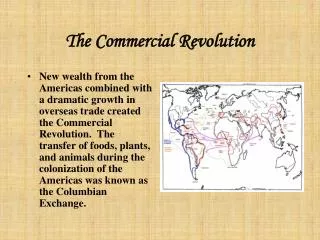
The Columbian Exchange • Europe’s growing population = demand for more goods and services • Trade expanded worldwide exchange of people, goods, technologies, ideas, diseases • Became known as the Columbian Exchange
The Columbian Exchange Europe Americas Wheat Corn Grapes Potatoes Livestock Chocolate Christianity Tomatoes Disease Beans Slaves (from Africa) Tobacco Asia Silk/Spices Sugarcane Coffee Tea
The Columbian Exchange • Effects • Cultural Diffusion- Local cultures integrated European beliefs (and vice versa) • Large movement of population (slavery, Eur.migration to New World) • Decline of Native American pop. due to disease (EX: smallpox)
The Great Circuit A “Triangular Trade Network”
GREAT CIRCUIT Knives, Swords, Guns, Cloth, Rum Sugar, Molasses, Cotton, Tobacco EUROPE 3 Mfr. goods Raw Materials 1 AMERICAS AFRICA 2 Middle Passage Enslaved Peoples