Download
1 / 1
10 likes | 120 Vues
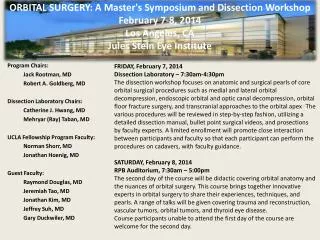
Join us for the Orbital Surgery: A Master's Symposium and Dissection Workshop at the Jules Stein Eye Institute in Los Angeles, CA. On February 7, participate in a hands-on dissection laboratory, focusing on key surgical techniques such as orbital decompression and fracture repair, guided by expert faculty. On February 8, attend didactic sessions covering orbital anatomy, trauma, tumors, and innovative surgical techniques. This unique training opportunity fosters close interaction between participants and renowned surgeons to enhance learning and skills in orbital surgery.

E N D
ORBITAL SURGERY: A Master's Symposium and Dissection WorkshopFebruary 7-8, 2014Los Angeles, CA Jules Stein Eye Institute Program Chairs: Jack Rootman, MD Robert A. Goldberg, MD Dissection Laboratory Chairs: Catherine J. Hwang, MD Mehryar (Ray) Taban, MD UCLA Fellowship Program Faculty: Norman Shorr, MD Jonathan Hoenig, MD Guest Faculty: Raymond Douglas, MD Jeremiah Tao, MD Jonathan Kim, MD Jeffrey Suh, MD Gary Duckwiler, MD FRIDAY, February 7, 2014 Dissection Laboratory – 7:30am-4:30pm The dissection workshop focuses on anatomic and surgical pearls of core orbital surgical procedures such as medial and lateral orbital decompression, endoscopic orbital and optic canal decompression, orbital floor fracture surgery, and transcranial approaches to the orbital apex . The various procedures will be reviewed in step-by-step fashion, utilizing a detailed dissection manual, bullet point surgical videos, and prosections by faculty experts. A limited enrollment will promote close interaction between participants and faculty so that each participant can perform the procedures on cadavers, with faculty guidance. SATURDAY, February 8, 2014 RPB Auditorium, 7:30am – 5:00pm The second day of the course will be didactic covering orbital anatomy and the nuances of orbital surgery. This course brings together innovative experts in orbital surgery to share their experiences, techniques, and pearls. A range of talks will be given covering trauma and reconstruction, vascular tumors, orbital tumors, and thyroid eye disease. Course participants unable to attend the first day of the course are welcome for the second day.