The Fascinating Gynandromorph: A Male and Female Tiger Swallowtail Explained
Discover the intriguing phenomenon of gynandromorphism in the Tiger Swallowtail butterfly. This unique specimen exhibits both male and female characteristics, showcasing the wonders of genetic development. Gynandromorphs arise when mitotic nondisjunction occurs during the early cell divisions, leading to a butterfly with distinct male (XY) and female (XX) traits. Our analysis explores how this genetic anomaly comes to life in the world of moths and butterflies. Witness the beauty of nature's complexity without any alterations!

The Fascinating Gynandromorph: A Male and Female Tiger Swallowtail Explained
E N D
Presentation Transcript
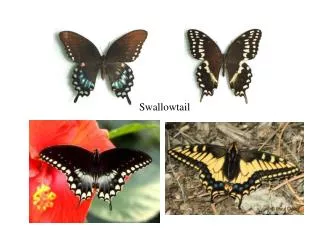
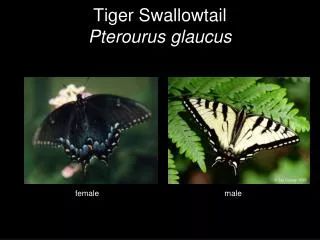
male female Tiger SwallowtailPterourus glaucus
male female What is up with this Tiger Swallowtail?
It’s a gynandromorph! • “gyn” means “female” • “andro” means “male” • “morph” means “form” • “Gynandromorph” literally means part female and part male.
How does this happen? • Normally, in moths & butterflies: • XX = Male • XY = Female • If the butterfly has two or more “X” chromosomes, it will develop as a male. With only one “X” chromosome, it will be a female. • In arthropods, the first cell division differentiates left from right. • Bilateral gynandromorphs arise by mitotic nondisjunction in the sex chromosomes at this one-two cell stage.
XX duplicated XXX X male female XX
Example #2 Male Female
Another Example: Blue Crab female male