Greek philosophers
70 likes | 194 Vues
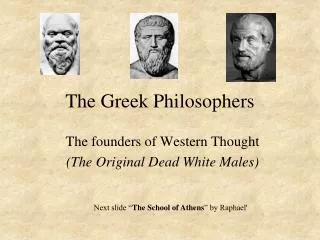
This chapter explores the contributions of Socrates, Plato, and Aristotle in shaping Western thought. Socrates, an Athenian sculptor turned philosopher, emphasized moral absolutes and the importance of questioning, despite facing backlash for his teachings. Plato, his student, introduced the concept of philosopher-kings in his work "The Republic". Aristotle, a prolific writer and thinker, highlighted the "golden mean" in ethics and advocated for a mixed government combining oligarchy and democracy. Their ideas continue to influence philosophy, politics, and science today.


Greek philosophers
E N D
Presentation Transcript
Greek philosophers Chapter 5 section 2
Socrates • Athenian sculptor, but true love was philosophy • Left no writings behind • There is an absolute right and wrong • Some Athenian leaders considered the Socratic method a threat • No longer trusted debate after the Peloponnesian War • Accused Socrates of teaching young Athenians to rebel against Athens • What happened to him?
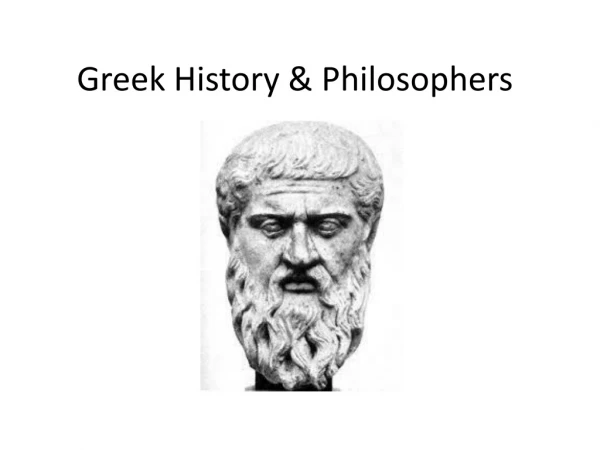
Plato • Student of Socrates • Wrote the Republic which explains his ideas for an ideal government • Top – philosopher kings • Warriors – defended the state • Rest of people – produced food, shelter and clothing *men & women should have equal chance for same jobs
Aristotle • Teacher pet to Plato • Wrote more than 200 books ranging from government to planets and stars • Opened his own school and taught “golden mean” • Science – grouped observations according to their differences and similarities • Best mixture of government is oligarchy and democracy
Aristotle • Ideas shaped the way Europeans and Americans thought about government • Founders of the United States Constitution tried to create a mixed government like Aristotle had identified!
Herodotus (hih-RAH-duh-tuhs) • Wrote the history of the Persians Wars • Tried to separate fact from legend • Still used some gods & goddesses to explain events • “father of history”
Thucydides(thoo-sih-duh-DEEZ) • Considered by some to be greatest historian of the ancient world • Fought in the Peloponnesian War • Wrote History of the Peloponnesian War while in exile after losing the War • Tried to use humans not gods to explain history • Stressed the importance of having accurate facts