Unlocking DNA: The Blueprint of Life and Protein Synthesis
DNA is the fundamental set of instructions for life, crucial for protein construction. Learn about its structure, replication, and the intricate processes of transcription and translation that enable the transformation of DNA into functional proteins. This overview highlights key discoveries such as the double helix model by Watson and Crick and delves into the roles of RNA in protein synthesis through messenger RNA (mRNA) and transfer RNA (tRNA). Explore how enzymes like RNA polymerase play vital roles in these processes, ensuring life is maintained at a molecular level.

Unlocking DNA: The Blueprint of Life and Protein Synthesis
E N D
Presentation Transcript
DNA Introduction
Do you think DNA is important? • T.V shows • Movies • Biotech Films • News • Cloning • Genetic Engineering
DNA cont. • At the most basic level DNA is a set of instructions for protein construction. • Structural • Enzymes • Hormones
What do you need to know? • Structure of DNA • How DNA replicates (reproduces)? • How DNA transcribes RNA? • How Ribosomes use the RNA to correctly assemble proteins?
Watson and Crick • Nobel Peace Prize • The Double Helix, 1953 • Outlined the Structure of the DNA • Discovered the “locking” of bases
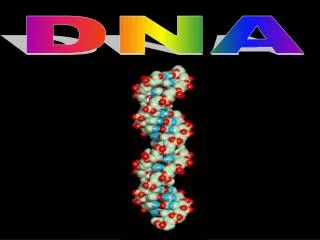
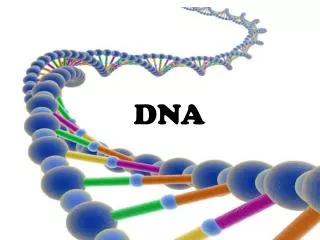
DNA Structure • DNA is a polymer. Each nucleotide consists of a 5-carbon sugar (deoxyribose), a nitrogen containing base attached to the sugar, and a phosphate group. • There are four different types of nucleotides found in DNA, differing only in the nitrogenous base. The four nucleotides are given one letter abbreviations as shorthand for the four bases. • A is for adenine • G is for guanine • C is for cytosine • T is for thymine
DNA Replication • DNA Replication Website • Produces 2 exact copies of DNA • Occurs just prior to cell division
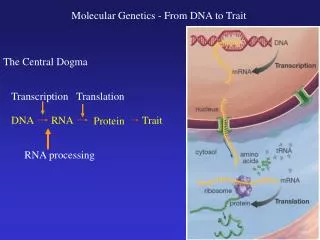
Protein Synthesis • The production (synthesis) of proteins. • 3 phases: 1. Transcription 2. RNA processing 3. Translation • Remember: DNA RNA Protein
Nuclear membrane DNA Transcription RNA Processing mRNA Ribosome Translation Protein DNA RNA Protein Eukaryotic Cell
Question: • How does RNA(ribonucleic acid) differ from DNA (deoxyribonucleic acid)?
RNA differs from DNA 1. RNA has a sugar ribose DNA has a sugar deoxyribose 2. RNA contains uracil (U) DNA has thymine (T) 3. RNA molecule is single-stranded DNA is double-stranded 4. RNAmolecule leaves the nucleus DNAstays in the nucleus 5. RNA is like a page/recipe DNA is like the whole book
Nuclear membrane DNA Transcription RNA Processing mRNA Ribosome Translation Protein 1. Transcription Eukaryotic Cell
1. Transcription • The transfer of information in the nucleus from a DNA molecule to an RNA molecule. • Only 1 DNA strand serves as the template • When complete, RNA molecule can be processed & released to the ribosomes.
Question: • What is the enzyme responsible for the production of the RNA molecule?
Answer: RNA Polymerase • Separates the DNA molecule by breaking the H-bonds between the bases. (Unzips the DNA) • Then moves along one of the DNA strands and lines up complementRNAnucleotides with DNA. • Bonds the sugar and phosphate groups of the RNA together. Does not bond the nitrogenous bases. • RNA leaves the area between the DNA strands. • DNAzips back up. • RNA is processed and leaves the nucleus.
DNA RNA Polymerase mRNA in construction 1. Transcription
Question: • What would be the complementary RNA strand for the following DNA sequence? • DNA GCGTATG
Answer: • DNA GCGTATG • RNA CGCAUAC
Nuclear membrane DNA Transcription RNA Processing mRNA Ribosome Translation Protein 2. RNA Processing Eukaryotic Cell
Types of RNA • Types ofRNA: A. messenger RNA (mRNA) B. transfer RNA (tRNA) • Remember: all produced in thenucleus!
A. Messenger RNA (mRNA) • Carries the information for a specific protein. • Made up of 500 to 1000 nucleotides long. • Made up of codons (sequence of three bases: AUG - methionine). • Each codon, is specific for an amino acid.
start codon A U G G G C U C C A U C G G C G C A U A A mRNA codon 1 codon 2 codon 3 codon 4 codon 5 codon 6 codon 7 stop codon protein methionine glycine serine isoleucine glycine alanine Primary structure of a protein aa2 aa3 aa4 aa5 aa6 aa1 peptide bonds A. Messenger RNA (mRNA)
B. Transfer RNA (tRNA) • Made up of 75 to 80 nucleotides long. • Picks up the appropriate amino acid floating in the cytoplasm • Transports amino acids to the mRNA. • Have anticodons that are opposites to mRNAcodons. • Recognizes the appropriate codons on the mRNA and bonds temporarily to them
amino acid attachment site methionine amino acid U A C anticodon B. Transfer RNA (tRNA)
Nuclear membrane DNA Transcription RNA Processing mRNA Ribosome Translation Protein 3. Translation Eukaryotic Cell
3. Translation • Synthesis of proteins in the cytoplasm • Involves the following: 1. mRNA (codons) 2. tRNA (anticodons) 3. ribosomes 4. amino acids
3. Translation • Three parts: 1. initiation: start codon (AUG) 2. elongation: building the polypeptide chain 3. termination: stop codon (UAG) • Let’s make a PROTEIN!!!!.
mRNA A U G C U A C U U C G 3. Translation Large subunit Small subunit
aa2 aa1 2-tRNA 1-tRNA G A U U A C Initiation anticodon A U G C U A C U U C G A hydrogen bonds codon mRNA
aa3 3-tRNA G A A Elongation peptide bond aa1 aa2 1-tRNA 2-tRNA anticodon U A C G A U A U G C U A C U U C G A hydrogen bonds codon mRNA
aa3 3-tRNA G A A aa1 peptide bond aa2 1-tRNA U A C (leaves) 2-tRNA G A U A U G C U A C U U C G A mRNA Ribosomes move over one codon
aa4 4-tRNA G C U peptide bonds aa1 aa2 aa3 2-tRNA 3-tRNA G A U G A A A U G C U A C U U C G A A C U mRNA
aa4 4-tRNA G C U peptide bonds aa1 aa2 aa3 2-tRNA G A U (leaves) 3-tRNA G A A A U G C U A C U U C G A A C U mRNA Ribosomes move over one codon
aa5 5-tRNA U G A peptide bonds aa1 aa2 aa4 aa3 3-tRNA 4-tRNA G A A G C U G C U A C U U C G A A C U mRNA
aa5 5-tRNA U G A peptide bonds aa1 aa2 aa3 aa4 3-tRNA G A A 4-tRNA G C U G C U A C U U C G A A C U mRNA Ribosomes move over one codon
aa5 aa4 Termination aa199 aa200 aa3 primary structure of a protein aa2 aa1 terminator or stop codon 200-tRNA A C U C A U G U U U A G mRNA
aa5 aa4 aa3 aa2 aa199 aa1 aa200 End Product • The end products of protein synthesis are the primary structure of a protein. • A sequence of amino acid bonded together by peptide bonds.
Question: • The anticodon UAC belongs to a tRNA that recognizes and binds to a particular amino acid. • What would be the DNA base code for this amino acid?
Answer: • tRNA - UAC (anticodon) • mRNA - AUG (codon) • DNA - TAC
incoming large subunit 1 2 3 4 5 6 7 mRNA incoming small subunit polypeptide Polyribosome • Groups of ribosomes reading same mRNA simultaneously producing many proteins (polypeptides).