Understanding Impulse and Momentum: Principles and Applications in Collisions
This unit explores the concepts of impulse and momentum, crucial to understanding physical interactions during collisions, as seen in everyday scenarios such as sports, car crashes, and safety mechanisms like airbags. Impulse, defined as the product of force and time, directly influences momentum, which is the product of mass and velocity. We learn how changing force, time, or both can significantly affect momentum. Real-world examples illustrate these principles, emphasizing that increasing impact time reduces impact force, enhancing safety during collisions.

Understanding Impulse and Momentum: Principles and Applications in Collisions
E N D
Presentation Transcript
Impulse and Momentum Unit 9
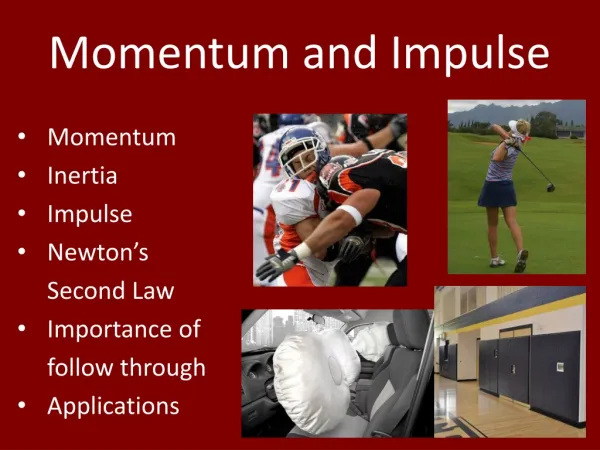
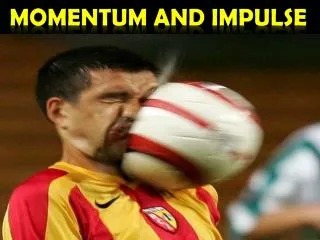
Impulse • Application of force during a small amount of time • Applies to COLLISIONS • Ball and bat • Racket and ball • Karate • Car on car • Airbags, yellow barrels on highway
Newton’s 2nd Law applies to all forces: SF = ma SF = mDv/Dt SFDt = mDv Left side SFDt is defined as IMPULSE Right side mDv is defined as MOMENTUM (p)
SFDt = mDv • Impulse = change in momentum • A net force applied in a time span will cause a change of velocity or acceleration • This restates Newton’s 2nd law
Momentum by itself is not interesting, but a change of momentum is! • Dp = mDv • How do you do this? • Change velocity • Change mass • Change both mass and velocity
You can also change impulse to create a change in momentum. • Dp = FDt • How do you do this? • Change force • Change time • Change both force and time
Example 1: Changing momentum • Ex. – hitting a ball -rocket engines -pushing a car -hit a ball • BIG force x BIG time = BIG D in momentum • Small force x small time = smallD in momentum
Example 2: Decreasing momentum over a LONG time • Ex. – airbags -bending knees -landing mats -circus safety nets -yellow water barrels on roads Car accident: Dp is same whether you hit a wall or a barrel Not safe Fwtw = Fbtb Safer Increasing IMPACT TIME reduces impact force
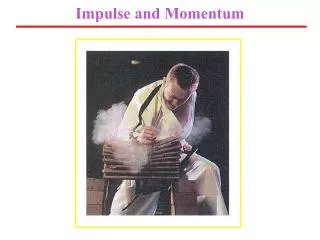
Example 3: Decreasing momentum in a SHORT time • Why would you want to lessen impact time to increase impact force?
Example 3: Decreasing momentum in a SHORT time • Why would you want to lessen impact time to increase impact force? Discovermagazine.com
What?? • Hand motion has large momentum as it approaches bricks (large Vi) • In hitting bricks, your hand experiences a large change of momentum (Vf = 0) • By bouncing hand off impact you REDUCE time of impact to a small amount • Result: Decreasing IMPACT TIME increases impact force
FOLLOW THROUGH Vi = -10 m/s Vf = -5 m/s FDt = mDv F=(1kg)(5m/s)/0.01 s F=500 N BOUNCE OFF Vi = -10 m/s Vf = +10 m/s FDt = mDv F=(1kg)(20m/s)/0.01 s F=2000 N Why does bouncing create BIGGER impact force? 1 kg board 1 kg board
Summary: Impulse = FDt Impulse is area under F vs. t graph Momentum p = mv Impulse = change in momentum FDt = mDv = Dp