Understanding Human Reproductive Anatomy: Male and Female Systems Explained
150 likes | 269 Vues
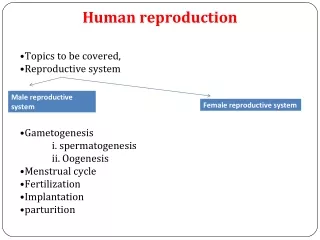
Reproduction is vital for the survival of species, involving the fusion of male and female gametes to create new genetic combinations. In humans, distinct male and female reproductive systems exist. The male gonads, or testes, produce sperm, while the female gonads, or ovaries, generate eggs. Fertilization occurs when these gametes combine to form a zygote, which develops into an embryo and then a fetus. Male sperm has a streamlined structure with a nucleus, acrosome, and tail, while female eggs contain a nucleus and yolk for nourishment, showcasing the complexity of human reproduction.


Understanding Human Reproductive Anatomy: Male and Female Systems Explained
E N D
Presentation Transcript
Human Reproduction Male and Female Reproductive Anatomy
Importance of Reproduction • Insures the survival of a species • Involves the fusion of male and female gametes to produce new genetic combinations • Humans have separate male and female reproductive systems: • Male gonads: testes produce cells called sperm • Female gonads: ovaries produce cells called eggs • The fusion of male and female sex cells is a process called fertilization • Zygote Embryo Fetus
Female Sex Cells: Eggs • Female gamete • Contains nucleus and stored food called yolk (used as nourishment for the developing animal) • Egg cells are microscopic (0.1mm in diameter
Male Sex Cells: Sperm • Also microscopic (but 100 000 times smaller then an egg) • Has a head, a mid-piece, and a tail • Streamlined with only a small amount of cytoplasm surrounding the nucleus • Head: nucleus which contains the chromosomes, and an acrosome which is filled with special enzymes that dissolve the outer coating surrounding the egg and thus penetrate the egg • Mid-piece: packed with mitochondria which provide energy so that the sperm can move • Flagellum: long whip-like tail which enables the sperm to swim through liquids