Presentation
A 61-year-old male presented with severe abdominal pain and a non-contrast CT scan revealing a ruptured abdominal aortic aneurysm (AAA). The patient was awake, alert, and hemodynamically stable upon arrival at Stanford via helicopter. After an immediate transfer to the operating room, surgical intervention was carried out for the AAA, with a GORE stent placement including a main body and bifurcation cuffs. The patient was monitored in the ICU and showed a steady recovery, transferring to the floor by post-operative day two and discharged home by day five.

Presentation
E N D
Presentation Transcript
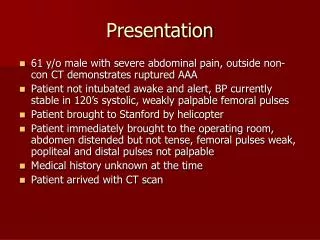
Presentation • 61 y/o male with severe abdominal pain, outside non-con CT demonstrates ruptured AAA • Patient not intubated awake and alert, BP currently stable in 120’s systolic, weakly palpable femoral pulses • Patient brought to Stanford by helicopter • Patient immediately brought to the operating room, abdomen distended but not tense, femoral pulses weak, popliteal and distal pulses not palpable • Medical history unknown at the time • Patient arrived with CT scan
Outside CT scan • Neck – angulated 22 to 23mm with about 10mm seal zone • Patient left most renal to closest hypogastric artery >190mm • Common iliac artery measures 18mm on right, 16mm on the left
Pre-deployment of GORE 28.5 x 14.5 x 160 main body
Contra limb on the right is 14.5 x 100mm Then extended with 20 x 140mm cuff
Post-operative course • Patient monitored in ICU with abdominal pressure checked regularly • Patient transferred to floor POD#2, discharged to home POD#5