The Rise of the Caliphate: Key Figures and Dynamics of Early Islamic Expansion (Up to 100 Characters)**
This piece explores the establishment and expansion of the Caliphate following Muhammad's death. It delves into the roles of the Rightly Guided Caliphs—Abu Bakr, Umar, Uthman, and Ali—and highlights the ensuing divisions between Sunni and Shi'a. The Umayyads' reign, marked by military conquests and internal conflicts, led to the Abbasid caliphate's emergence. The growth of Muslim trade networks and the cultural flourishing in cities like Cordoba and Baghdad demonstrate the far-reaching impact of the Islamic civilization across three continents. (497 Characters)


The Rise of the Caliphate: Key Figures and Dynamics of Early Islamic Expansion (Up to 100 Characters)**
E N D
Presentation Transcript
Islam Expands Chapter 10 Section 2
Caliph • Umayyads • Shi’a • Sunni • Sufi • Abbasids • Al-Andulas • Fatimid Key Terms
Muhammad had not named a successor • Abu-Baker loyal friend • Caliph- means successor or deputy Muhammad’s Successors Spread Islam
Umar, Uthman, and Ali all had know Muhammad • Rule was called caliphate • Jihad-striving against evil • Encouraged and justified expansion Right Guided Caliphs
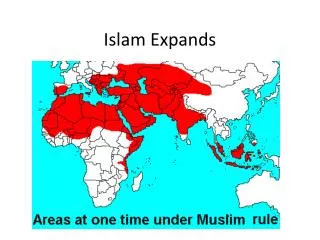
634 AD Muslim state controlled Arabia • Umar second caliph conquered Syria and Egypt • Uthman and Ali expanded territory from Atlantic ocean to Indus River Right Guided Caliphs
Muhammad had expressed desire to spread Islam • Victories a sign of Allah’s support • Gave energy and inspiration • Willing to struggle Reasons for Success
Muslim armies well trained and disciplined • Weakness in other empires • Persecuted people often welcomed invaders • Attracted to message of equality and hope Reasons for Success
Muslims allowed conquered people to keep their religions • Christians and Jews paid a poll tax in exchange for exception of military duties • Subject to various restriction • Could not spread religion but could be officials and scholars Treatment of Conquered People
656 Uthman murdered • Ali rightful ruler • Challenged by Muyawiya governor of Syria • Ali was assassinated • Umayyads-family that came to power Internal Conflict Creates Crisis
Moved Muslim capitol to Damascus • Made controlling conquered territories easier • Surrounded themselves with wealth and ceremony • Started a split Internal Conflict and Crisis
Majority of Muslims adopted Umayyads rule • Shi’a- party of Ali • Caliph needed to be a descendant of Muhammad • Sunni- Umayyads became know as followers of Muhammad’s example • Sufi-life of poverty and devotion Sunni- Shi’a Split
Abbasid came to power in 750 • Murders the Umayyad family • Abh al-Rahmanb escaped to Spain • Set up Umayyad caliphate Control Extends Over Three Continents
Moved capitol to Baghdad • Key route gave caliphs access to trade good • Developed strong bureracracy • Treasury kept track of money flows • Special department managed the army Abbasids Consolidate Power
Abbasids taxed land, imports and exports, and non-Muslim wealth • Rival groups divide Muslim lands • 1258 Fatimid caliphate was formed • Desecendant from Muhammad’s daughter Fatima Rival Groups Divide Muslim Lands
Started in Africa and spread to the Red Sea • Muslim trade network • Engaged in sea trade with the world • Land connected China, India, Europe and Africa • Merchants needed a single language • Single currency Muslim Trade Networks
Muslims set up banks in cities (money changers) • Offered letters of credit (sakks) • Could exchange it for cash in any other city • Europe pronounced it as check Muslim Trade Networks
Cordoba-10 century had a population of 200,000 • Paris had 38,000 • City attracted, poets, philosophers, and scientists • Cordoba, Damascus, Cairo and Baghdad fueled period of immense achievements in the arts and sciences Muslim Trade Networks