Enhancing Cache Performance: Compiler Techniques to Reduce Cache Misses
This overview discusses innovative compiler optimizations aimed at significantly reducing cache misses, inspired by McFarling's 1989 work, which achieved a 75% reduction on an 8KB direct-mapped cache. Key techniques include procedure reordering to mitigate conflict misses, array merging to enhance spatial locality, loop interchange to optimize data access patterns, loop fusion for independent loops, and blocking to maximize temporal locality. Each method is illustrated with before-and-after code examples, highlighting their effectiveness in improving cache performance and overall computational efficiency.

Enhancing Cache Performance: Compiler Techniques to Reduce Cache Misses
E N D
Presentation Transcript
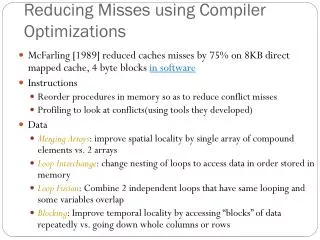
Reducing Misses using Compiler Optimizations • McFarling [1989] reduced caches misses by 75% on 8KB direct mapped cache, 4 byte blocks in software • Instructions • Reorder procedures in memory so as to reduce conflict misses • Profiling to look at conflicts(using tools they developed) • Data • Merging Arrays: improve spatial locality by single array of compound elements vs. 2 arrays • Loop Interchange: change nesting of loops to access data in order stored in memory • Loop Fusion: Combine 2 independent loops that have same looping and some variables overlap • Blocking: Improve temporal locality by accessing “blocks” of data repeatedly vs. going down whole columns or rows
Merging Arrays Example /* Before: 2 sequential arrays */ int val[SIZE]; int key[SIZE]; /* After: 1 array of stuctures */ struct merge { int val; int key; }; struct merge merged_array[SIZE]; Reducing conflicts between val & key; improve spatial locality
Loop Interchange Example /* Before */ for (k = 0; k < 100; k = k+1) for (j = 0; j < 100; j = j+1) for (i = 0; i < 5000; i = i+1) x[i][j] = 2 * x[i][j]; /* After */ for (k = 0; k < 100; k = k+1) for (i = 0; i < 5000; i = i+1) for (j = 0; j < 100; j = j+1) x[i][j] = 2 * x[i][j]; Sequential accesses instead of striding through memory every 100 words; improved spatial locality
Loop Fusion Example /* Before */ for (i = 0; i < N; i = i+1) for (j = 0; j < N; j = j+1) a[i][j]= 1/b[i][j] * c[i][j]; for (i = 0; i < N; i = i+1) for (j = 0; j < N; j = j+1) d[i][j] = a[i][j]+ c[i][j]; /* After */ for (i = 0; i < N; i = i+1) for (j = 0; j < N; j = j+1) { a[i][j] = 1/b[i][j] * c[i][j]; d[i][j] = a[i][j] + c[i][j];} 2 misses per access to a & c vs. one miss per access; improve spatial locality
Blocking Example /* Before */ for (i = 0; i < N; i = i+1) for (j = 0; j < N; j = j+1) {r = 0; for (k = 0; k < N; k = k+1){ r = r + y[i][k]*z[k][j];}; x[i][j] = r; }; • Two Inner Loops: • Read all NxN elements of z[] • Read N elements of 1 row of y[] repeatedly • Write N elements of 1 row of x[] • Capacity Misses a function of N & Cache Size: • 2N3 + N2 => (assuming no conflict; otherwise …) • Idea: compute on BxB submatrix that fits
Blocking Example /* After */ for (jj = 0; jj < N; jj = jj+B) for (kk = 0; kk < N; kk = kk+B) for (i = 0; i < N; i = i+1) for (j = jj; j < min(jj+B-1,N); j = j+1) {r = 0; for (k = kk; k < min(kk+B-1,N); k = k+1) { r = r + y[i][k]*z[k][j];}; x[i][j] = x[i][j] + r; }; • B called Blocking Factor
Reducing Conflict Misses by Blocking • Conflict misses in caches not FA vs. Blocking size • Lam et al [1991] a blocking factor of 24 had a fifth the misses vs. 48 despite both fit in cache
Summary of Compiler Optimizations to Reduce Cache Misses (by hand)