Understanding Enthalpy Changes: Formation and Combustion Reactions Under Standard Conditions
This guide explains the concepts of standard conditions, enthalpy changes of reaction, formation, and combustion. It details the standard enthalpy change of formation (( Delta H^circ_f )), illustrating how one mole of a compound is formed from its elements in their standard states. The guide also covers combustion reactions (( Delta H^circ_c )), showcasing equations for various compounds like methane, ethanol, and magnesium oxide. Additionally, it provides a practical example for calculating enthalpy changes from experimental data.

Understanding Enthalpy Changes: Formation and Combustion Reactions Under Standard Conditions
E N D
Presentation Transcript
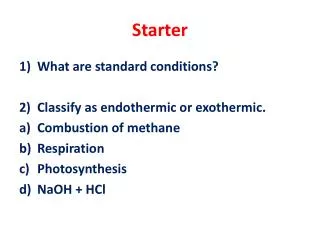
Starter • What are standard conditions? • Classify as endothermic or exothermic. • Combustion of methane • Respiration • Photosynthesis • NaOH + HCl
Determination of Enthalpy Changes L.O.: Define and use the terms: standard conditions; enthalpy change of reaction; enthalpy change of formation; and enthalpy change of combustion.
Standard enthalpy change of formation , ∆Hѳf, of a compound is the enthalpy change that takes place when one mole of a compound is formed from its constituent elements in their standard state under standard conditions. • Example(s): C(s,graphite) + O2(g) ———> CO2(g) H2(g) + ½O2(g) ———> H2O(l) 2C(s,graphite) + ½O2(g) + 3H2(g) ——>C2H5OH(l)
Task: Write equations for standard enthalpy change of formation for • C3H8 • MgO • Ethanol • Al2O3
Standard enthalpy change of combustion, ∆Hѳc, is the enthalpy change that takes place when one mole of a substance reacts completely with oxygen under standard conditions, all reactants and products being in their standard state. Example(s): C(s, graphite) + O2(g) ———> CO2(g) H2(g) + ½O2(g) ———> H2O(l) C2H5OH(l) + 3O2(g) ———> 2CO2(g) + 3H2O(l)
Task: Write equations for the change that occurs during the enthalpy change of formation of: • CH4 • MgO • Ethanol • Al2O3
L.O.: • Calculate enthalpy changes directly from appropriate experimental results, including the use of the relationship: energy change = mcΔT.
An excess of magnesium is added to to 100cm3 of 2.00 mol dm-3 CuSO4(aq). The temperature increases from 20.0 to 65.0 oC. Find the enthalpy change for this reaction (c= 4.18 Jg-1k-1)