Overview of the Argo-Oxygen Program: Advancements in Ocean O2 Measurement
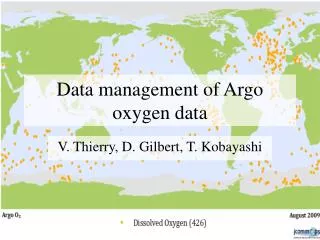
This white paper, authored by a team led by Nicolas Gruber, presents the scientific rationale for measuring sub-seasonal to decadal changes in oceanic oxygen (O2). O2 levels are sensitive to variations in circulation and biological activity, making them crucial for understanding oceanic production and O2 outgassing. Innovations in sensor technology promise improved drift and accuracy, paving the way for a coordinated pilot study supported by AST. The implementation phase involves deploying approximately 100 floats in key areas, integrating data with biogeochemical models to enhance our understanding of marine oxygen dynamics.

Overview of the Argo-Oxygen Program: Advancements in Ocean O2 Measurement
E N D
Presentation Transcript
Argo-Oxygen Program Overview • White paper produced by writing team lead by Nicolas Gruber • Scientific justification for measuring sub-seasonal to decadal O2 changes: • O2 is rather sensitive to changes in circulation and biology • Subsurface O2 changes are an indication of oceanic export production • Important to understand ocean O2 outgassing for interpretation of the atmospheric O2 record • New sensor technology means drift and accuracy can be within the required limits OOPC 12th Session UNESCO
Argo-Oxygen Program update • White paper presented to the AST-8 in March • Well received & AST supported Dr Gruber’s propsal for a coordinated pilot study • AST concerned over the effect on battery life, float failure rates, cost, and implications for current legal agreements • For the pilot study, it was agreed that SIC would oversee the project for the next phase and that Dr Gruber will continue to lead the Argo-Oxygen team. OOPC 12th Session UNESCO
Technical issues • Choice of floats (ARGOS vs Iridium) • CTD pumps, data upload rates • Sensors types (IDO vs Optode) • Accuracy, drift • Adding O2 reduces battery life by 10-30% (can be compensated by more efficient Seabird CTD pump) • Increased cost (inc. sensors, data transfer) is 20-30%, and around 40% when reduced float lifetime is taken into account OOPC 12th Session UNESCO
Implementation Phase • Deploy around 100 floats in a concentrated area of scientific interest (i.e. Nth Atlantic, Nth Pacific) • Cost for 2 years of floats ~$2.5M + ship time + regular Winkler titrations from ships to validate float obs • Integrate pilot study with i.e. biogechemical modelling studies to estimate export production OOPC 12th Session UNESCO