Counting Permutations When Indistinguishable Objects May Exist
This guide explores how to calculate the number of distinct permutations of rows comprising indistinguishable objects. Using an example with 3 A's, 1 B, and 4 C's, we find the total number of unique arrangements with the formula (n)! / (n1! * ... * nk!), where n is the total number of items and ni represents the count of type i objects. By understanding this concept, one can apply it to any scenario involving k distinct object types and their respective counts, allowing for efficient counting of arrangements in various contexts.

Counting Permutations When Indistinguishable Objects May Exist
E N D
Presentation Transcript
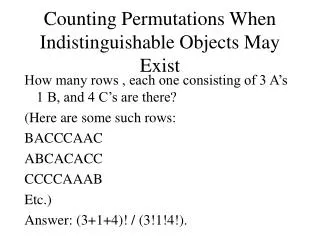
Counting Permutations When Indistinguishable Objects May Exist How many rows , each one consisting of 3 A’s 1 B, and 4 C’s are there? (Here are some such rows: BACCCAAC ABCACACC CCCCAAAB Etc.) Answer: (3+1+4)! / (3!1!4!).
In general: k distinct types of objects are given, where k is a positive integer. Positive integers ni for i=1,…k are given. k is a given positive integer. How many rows are there, each one including ni objects of type i for i=1, …, k and no other objects? Answer: Let n=n1 + … +nk. Then the number of rows is n!/(n1! … nk!).