Understanding Monopolies: Market Power, Pricing Strategies, and Regulation
This overview explores the concept of monopolies, characterized by a single supplier dominating a market. Monopolies create high barriers to entry for competitors, exemplified by firms like DeBeers in the diamond industry. While they can offer economies of scale, allowing costs to drop over time, they also often exploit consumers with high prices. The essay addresses the various types of monopolies, including natural monopolies and government-created monopolies through patents and franchises. Additionally, it examines price discrimination and the ethical implications tied to monopolistic practices.

Understanding Monopolies: Market Power, Pricing Strategies, and Regulation
E N D
Presentation Transcript
Monopolies • Single supplier for a good or service • Barriers exist for entry into market for firms • DeBeers-diamonds • Problem- monopolies can charge high $$$ and take advantage of consumers • United States has outlawed/regulated monoploies
Forming a monopoly • Single seller in market- but there are different types of monopolies • Economies of scale- start up costs high, but average cost fall with each new unit produced • Figure 7.3 compares economies of scale • Example- hydroelectric plant • Start up- a dam- very expensive • Average cost will dissipate over time
Natural monopolies • A market where one firm is most efficient for industry • Competition would drive 2 firms out of market because of lack of profit • Public Water works-pipes, work, quality • Government regulation on utilities • Natural monopolies agree to govt oversight • Technology can change- cell phones- no wires
Government monopolies • A monopoly created by government • Patents- exclusive rights to a good or service • Book- Leland pharmaceuticals develops asthma medicine- get a 20 year patent • Guarantees company opportunity to profit from their own research- R&D in companies • Franchise- contract issued by local authority allowing single firm exclusive rights- ATL
monopolies • Licensing- government requires a license into market- radio, television, parking • Industrial organizations- MLB, NFL, NHL, NBA • Allows efficiency of industry • Also allows owners opportunity to abuse with prices etc,,, • Oakland Raiders • LA- back to Oakland- new stadium , etc
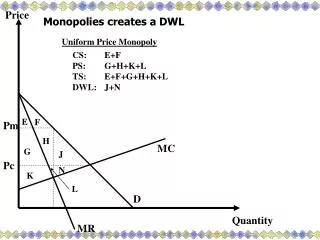
Output decisions • Monopolies- usually produce fewer good at charge higher prices • React differently to perfectly competitive markets • Reason- falling marginal revenue. • Keep prices high and supply low. ALL CONSUMERS CHARGED SAME PRICE. • Seems unfair- but it is how the company can continue to produce good – incentive
Price discrimination • When monopolists divide customers into categories and charge different prices. • Sets price high- sells only to few • Set price low- popular but limited profit • Market Power-ability to control prices and and total market output. • Price discrimination examples- discounted airfare, manufacturer’s rebates, senior/student discount, child fly, eat stay free
Limits on price discrimination • Must have 3 conditions • 1. Firms must have control over price- usually rare in highly competitive markets • 2. Distinct customer groups- guess the price curve and elasticity for these groups • 3. Difficult resale- goods usually consume on the spot . • Some feel price discrimination is wrong