Download
1 / 2
20 likes | 128 Vues
This research by Michael D. Fayer at Stanford University explores new ultrafast infrared experimental methods to investigate disordered molecular systems, crucial in fields ranging from astronomy to zoology. The study focuses on materials like liquid crystals, alcohols, and supercooled liquids, all characterized by irregular structures. By employing techniques akin to multidimensional NMR, the team examines microscopic structural dynamics on ultrafast timescales. Insights from this work will aid in controlling and utilizing complex systems and their behaviors.

E N D
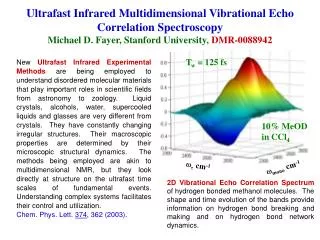
Tw = 125 fs 10% MeOD in CCl4 wt cm-1 wmono cm-1 Ultrafast Infrared Multidimensional Vibrational Echo Correlation SpectroscopyMichael D. Fayer, Stanford University,DMR-0088942 New Ultrafast Infrared Experimental Methods are being employed to understand disordered molecular materials that play important roles in scientific fields from astronomy to zoology. Liquid crystals, alcohols, water, supercooled liquids and glasses are very different from crystals. They have constantly changing irregular structures. Their macroscopic properties are determined by their microscopic structural dynamics. The methods being employed are akin to multidimensional NMR, but they look directly at structure on the ultrafast time scales of fundamental events. Understanding complex systems facilitates their control and utilization. Chem. Phys. Lett. 374, 362 (2003). 2D Vibrational Echo Correlation Spectrumof hydrogen bonded methanol molecules. The shape and time evolution of the bands provide information on hydrogen bond breaking and making and on hydrogen bond network dynamics.
h2 Ultrafast Infrared Multidimensional Vibrational Echo Correlation SpectroscopyMichael D. Fayer, Stanford University,DMR-0088942 Outreach: The PI developed a Power Point slide show for teaching Freshman Chemistry. It has been provided to high school teachers such as Cesar Delgado, American School Foundation, Col. Las Americas, Mexico. Education: Three graduate students (Chris Stromberg, Ivan Piletic, and Alexei Goun) and three postdocs (John Asbury, Tobias Steinel, and Kelly Gaffney) contributed to this work. Kelly Gaffney has just started as an Assistant Professor at the Stanford Synchrotron Radiation Laboratory. Chris Stromberg is currently teaching at Pomona College. Chris plans to continue teaching chemistry at the college level. John Asbury is headed to an academic position at a major research university. Tobias Steinel is the recipient of a Humboldt Fellowship, and will go into academia when he returns to Germany. Ivan Piletic and Alexei Goun are continuing their Ph.D. studies in Chemistry and Physics, respectively. Force inside on piston Fi = PiAForce outside on piston Fext = PextA h1 Pi > Pext Pull out pin, piston will move up.