
10 likes | 133 Vues
This paper presents an innovative approach to test scheduling for 3D stacked integrated circuits (ICs) using Through-Silicon Vias (TSVs). The study aims to reduce overall test time during both wafer sort and package testing while considering the hardware costs associated with Test Data Registers (TDRs). By co-optimizing the test schedule for 3D stacked ICs, the authors highlight the trade-offs between test time and TDR usage, demonstrating that simultaneous testing of cores from different chips can lead to significant reductions in test duration and costs.
E N D
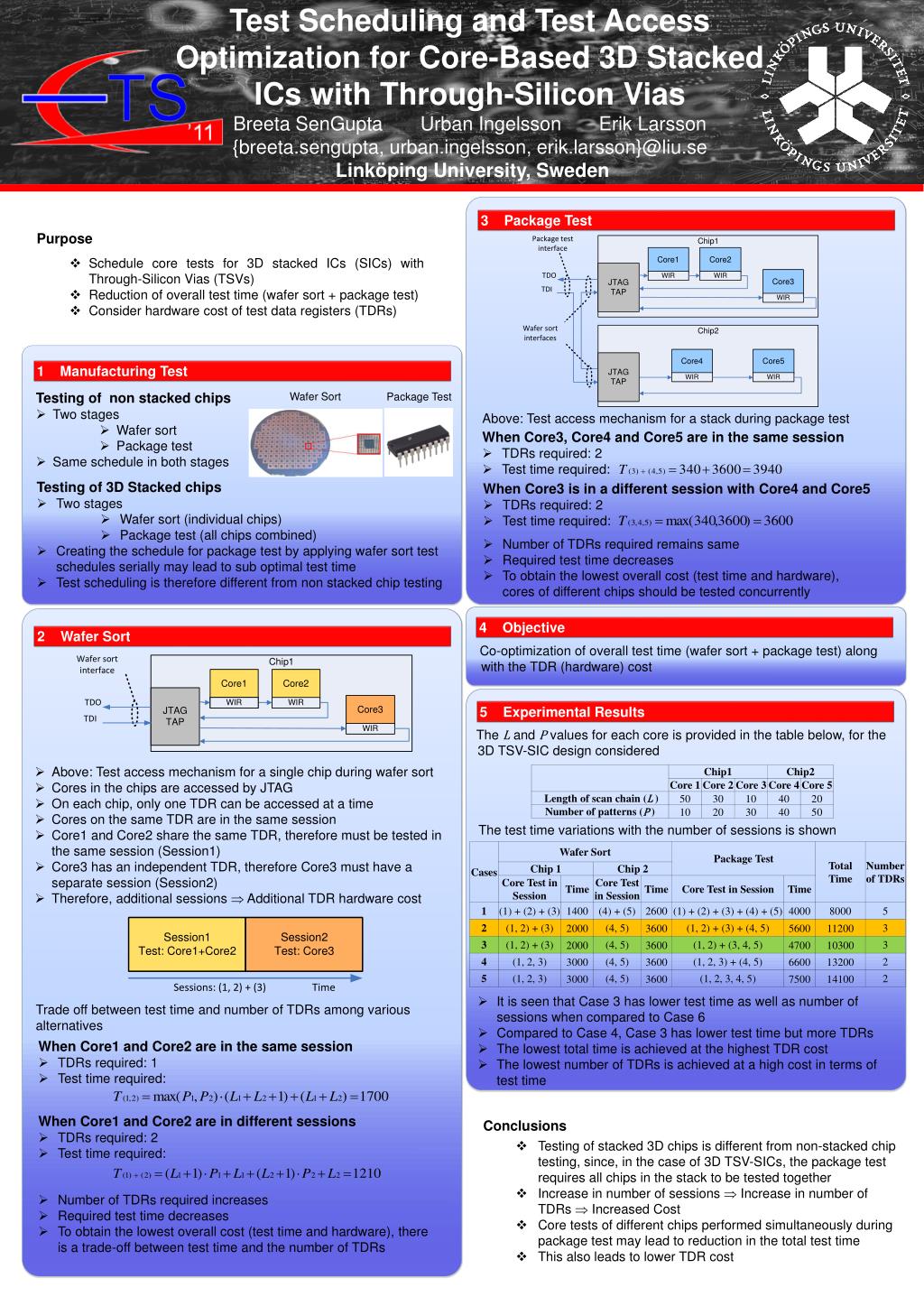
Test Scheduling and Test Access Optimization for Core-Based 3D Stacked ICs with Through-Silicon ViasBreeta SenGuptaUrban Ingelsson Erik Larsson{breeta.sengupta, urban.ingelsson, erik.larsson}@liu.se Linköping University, Sweden • Purpose • Schedule core tests for 3D stacked ICs (SICs) with Through-Silicon Vias (TSVs) • Reduction of overall test time (wafer sort + package test) • Consider hardware cost of test data registers (TDRs) Wafer Sort Package Test 1 Manufacturing Test 2 Wafer Sort • Testing of non stacked chips • Two stages • Wafer sort • Package test • Same schedule in both stages • Testing of 3D Stacked chips • Two stages • Wafer sort (individual chips) • Package test (all chips combined) • Creating the schedule for package test by applying wafer sort test schedules serially may lead to sub optimal test time • Test scheduling is therefore different from non stacked chip testing 3 Package Test • Above: Test access mechanism for a single chip during wafer sort • Cores in the chips are accessed by JTAG • On each chip, only one TDR can be accessed at a time • Cores on the same TDR are in the same session • Core1 and Core2 share the same TDR, therefore must be tested in the same session (Session1) • Core3 has an independent TDR, therefore Core3 must have a separate session (Session2) • Therefore, additional sessions Additional TDR hardware cost • The L and P values for each core is provided in the table below, for the 3D TSV-SIC design considered • Co-optimization of overall test time (wafer sort + package test) along with the TDR (hardware) cost 4 Objective Above: Test access mechanism for a stack during package test • When Core3, Core4 and Core5 are in the same session • TDRs required: 2 • Test time required: • The test time variations with the number of sessions is shown • Trade off between test time and number of TDRs among various alternatives • When Core3 is in a different session with Core4 and Core5 • TDRs required: 2 • Test time required: • When Core1 and Core2 are in the same session • TDRs required: 1 • Test time required: • Number of TDRs required remains same • Required test time decreases • To obtain the lowest overall cost (test time and hardware), cores of different chips should be tested concurrently • When Core1 and Core2 are in different sessions • TDRs required: 2 • Test time required: • Number of TDRs required increases • Required test time decreases • To obtain the lowest overall cost (test time and hardware), there is a trade-off between test time and the number of TDRs 5Experimental Results • Conclusions • Testing of stacked 3D chips is different from non-stacked chip testing, since, in the case of 3DTSV-SICs, the package test requires all chips in the stack to be tested together • Increase in number of sessions Increase in number of TDRs Increased Cost • Core tests of different chips performed simultaneously during package test may lead to reduction in the total test time • This also leads to lower TDR cost • It is seen that Case 3 has lower test time as well as number of sessions when compared to Case 6 • Compared to Case 4, Case 3 has lower test time but more TDRs • The lowest total time is achieved at the highest TDR cost • The lowest number of TDRs is achieved at a high cost in terms of test time