Understanding Min-Max Heaps and Deaps: Efficient Double-Ended Priority Queues
This chapter delves into the concepts of min-max heaps and deaps, exploring their structures and operations. A min-max heap is a complete binary tree with alternating min and max levels, allowing efficient insertions and deletions of elements with arbitrary keys. It supports operations like inserting and deleting both the largest and smallest elements. A deap combines properties of min-heaps and max-heaps, optimizing certain operations. Practical examples demonstrate insertion and deletion procedures, highlighting their time complexities and advantages over traditional heaps.

Understanding Min-Max Heaps and Deaps: Efficient Double-Ended Priority Queues
E N D
Presentation Transcript
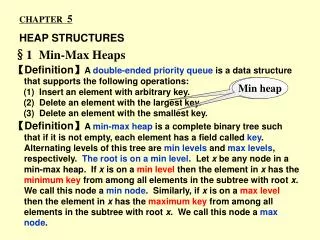
CHAPTER 5 HEAP STRUCTURES §1 Min-Max Heaps 【Definition】A double-ended priority queue is a data structure that supports the following operations: (1) Insert an element with arbitrary key. (2) Delete an element with the largest key. (3) Delete an element with the smallest key. Max heap Min heap 【Definition】A min-max heap is a complete binary tree such that if it is not empty, each element has a field called key. Alternating levels of this tree are min levels and max levels, respectively. The root is on a min level. Let x be any node in a min-max heap. If x is on a min level then the element in x has the minimum key from among all elements in the subtree with root x. We call this node a min node. Similarly, if x is on a max level then the element in x has the maximum key from among all elements in the subtree with root x. We call this node a max node.
§1 Min-Max Heaps min max min max 7 70 40 10 30 9 15 20 12 45 50 30 grandparent grandparent 〖Example〗 heap[0] = 5 7 5 Find the minimum parent 80? 80 parent parent 10 7 5? 40? 40 10 5? 40 80? 1. Insertion 〖Example〗 Insert the element with key 5 〖Example〗 Insert the element with key 80 The program min_max_insert is given by Program 9.1 on p.434. Tp = O( height ) = O( ln n ) 2. Deletion of Min Element ( the root ) The program delete_min is given by Program 9.3 on p.438. Tp = O( height ) = O( ln n )
5 10 8 25 15 30 20 19 9 45 40 §2 Deaps 【Definition】A deap is a complete binary tree that is either empty or satisfies the following properties: (1) The root contains no element. (2) The left subtree is a min-heap. (3) The right subtree is a max-heap. (4) If the right subtree is not empty, then let i be any node in the left subtree. Let j be the corresponding node in the right subtree. If such a j does not exist, then let j be the node in the right subtree that corresponds to the parent of i. The key in node i is less than or equal to the key in j. Faster than min-max heap’s algorithms by a constant factor and its algorithms are simpler. 〖Example〗
§2 Deaps 5 10 8 25 15 30 20 19 9 45 40 deap[0]=4 5 4 10 40 5 4 40 42 19 40 4 10 40 19 25 42 40 max heap max heap 1. Insertion min heap min partner min partner max partner 〖Example〗 Insert the element with key 4 < 19 〖Example〗 Insert the element with key 42 > 9 The program deap_insert is given by Program 9.4 on p.443. Tp = O( height ) = O( ln n ) 2. Deletion of Min Element ( the root of the min-heap ) The program deap_delete_min is given by Program 9.5 on p.444. Tp = O( height ) = O( ln n )