Download
1 / 27
270 likes | 410 Vues
At a local pizzeria open 24 hours (except from 2 AM to 8 AM), patrons engage in a creative voting exercise that reflects on their values and beliefs regarding leadership. Amidst quirky questions and an inviting atmosphere, three candidates are presented for election: Candidate A, corrupt and indulgent; Candidate B, erratic and troubled; and Candidate C, a principled war hero. This light-hearted yet profound moment encourages diners to reflect on the characteristics of leadership, the influence of totalitarianism, and the fundamental differences between fascism and communism, all while making choices that affect their world.

E N D
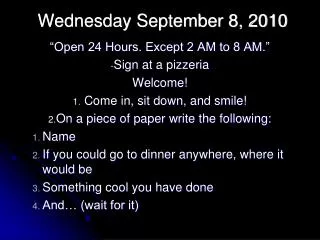
Wednesday September 8, 2010 “Open 24 Hours. Except 2 AM to 8 AM.” Sign at a pizzeria Welcome! Come in, sit down, and smile! On a piece of paper write the following: Name If you could go to dinner anywhere, where it would be Something cool you have done And… (wait for it)
…this It is time to elect a new world leader, and only your vote counts. Here are the facts about the three candidates. Candidate A: Associates with crooked politicians, and consults with astrologists. He's had two mistresses. He also chain smokes and drinks 8 to 10 martinis a day. Candidate B: He was kicked out of office twice, sleeps until noon, used opium in college and drinks a quart of whiskey every evening. Candidate C: He is a decorated war hero. He's a vegetarian, doesn't smoke, drinks an occasional beer and never cheated on his wife. Which of these candidates would be your choice?
3 Characteristics • 1. No opposition • 2. Total control of every aspect of life • 3. Highly centralized government
Weapons of Totalitarian Governments • 1. Police terror • 2. indoctrination • 3. propaganda • 4. religious persecution • 5. censorship
Examples at the beginning of WWII • Spain – Francisco Franco • Russia – Joseph Stalin • Italy – Benito Mussolini • Germany – Adolf Hitler
Fascism • Extreme form of nationalism • Denial of individual rights • Dictatorship
Communism (as intended) • Economic system • All means of production are owned by the people • Private property does not exist • Goods and services are shared equally
Communism (basic beliefs) • Man is good • Individual is important • People are equal • Private property is bad
Fascism (basic beliefs) • Man needs a strong ruler • State (nation) is most important thing • Some people are better than others
Communism (Economics) • All means of production should be owned by the state and shared equally with the workers • Production will be planned by the government
Fascism (Economics) • Supply and demand • Free enterprise • Private ownership • (all in theory, not reality)
Communism (Foreign Policy) • Encourage spread of communism to other countries
Fascism (Foreign policy) • Take territory away from inferior nations • Be strong
Communism (Religion) • No religion allowed (Communism is the religion)
Fascism (religion) • Religious freedom, but frowned upon
Communism (symbols) • Color – red • Hammer and sickle • Red Star
Fascism (Symbols) • Swastika • Fasces
Communism (Society) • Classless – everyone is equal
Fascism (society) • Similar to ours – more or less
Communism (Targeted Groups) • Landowners • Wealthy • intellectuals
Fascism (targeted groups) • Jews • Gypsies • Handicapped • Slavs • Sick • Elderly • Anyone considered inferior
Communism (Nations) • USSR • Eventually • China • N. Korea • Cuba • East Germany • Poland • N. Vietnam • Many others
Fascism (Nations) • Italy • Germany • Spain
Vocabulary/People (pp.758-771) • Totalitarian State (sec. 2) • Fascism (sec. 2) • Benito Mussolini (sec. 2) • Joseph Stalin (sec. 2) • Francisco Franco (sec. 2) • Adolf Hitler (sec. 3) • Mein Kampf (sec. 3) • Heinrich Himmler (sec. 3) • Concentration camp (sec. 3) • Nuremberg Laws (sec. 3)