Download
1 / 8
80 likes | 251 Vues
Farriery is a skilled profession focused on the care and shoeing of horses, requiring knowledge of hoof anatomy and shoe fitting. Farriers inspect and treat horses' hooves, ensuring proper footwear and corrective measures when necessary. They typically work outdoors and travel to different locations, carrying their tools. While formal education is not mandatory, training in equine science or blacksmithing is beneficial. The career offers growth opportunities with varying salaries based on experience and dedication, making it a rewarding choice for those passionate about horses.

E N D
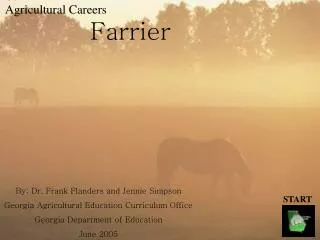
Agricultural Careers Farrier By: Dr. Frank Flanders and Jennie Simpson Georgia Agricultural Education Curriculum Office Georgia Department of Education June 2005 START
What Is a Farrier? • Farriery is a skilled job, requiring sound knowledge of the theory and practice of shoeing horses. • Farriers check a horse’s leg, foot and hoof and undertake any remedial work necessary before fitting the most appropriate shoe for its size, foot condition and type of activity or work. • Most of a farrier’s work is in daylight hours, including weekends, but actual hours vary according to the needs of their customers. • Farriers go to their customers’ premises to work, traveling between the different locations and carrying a mobile workshop of tools and stock with them.
Duties of a Farrier • Observe horses’ legs and hooves while the horse is stationary and in motion to check for any peculiarities in movement or abnormalities in the size or shape of the hoof. • Remove old shoes and note wear patterns • Inspect, clean, trim, and shape the horses’ hooves. • Consult with owner or trainer regarding proper shoes for working conditions • Create sketches and drawings for proposed shoe • Heat shoes in a forge, shape them on anvil and hammer to appropriate size • Place and nail shoes on hooves and ensure that footwear is smoothly lined up with hoof walls
Becoming a Farrier • An ideal farrier must be able to work alone, but also deal well with the public and relate well to clients. • They should enjoy working outdoors and like to travel fairly extensively. • A farrier must have a love for horses and enjoy working with animals. • Skills such as being task oriented, patient and being able to work quickly, efficiently and to remain focused for long periods of time are necessary.
Education • There is no formal education required to become a farrier, however some type of secondary training focused on farriery or equine science is considered advantageous. • A degree in business might help with running the farrier business. • College classes related to equine science, metal work, and blacksmithing would be helpful. • Most farriers complete an apprenticeship with a master farrier to gain practical experience after attending a farrier school. • Apprenticeships can last several years.
Employment • Salary depends on how much time and effort an individual puts into this career and whether they work full time or part time. • The average salary for a full time farrier is $18,367 per year. • Those with expertise can earn $22,000 or more per year. • Due to the continued growth of the horse industry, job opportunities as a farrier will continue to grow at an average rate. • A person with adequate training and experience should not have difficulty finding a supportive business as a farrier.
Animal Scientist • Horse Trainer • Veterinarian • Veterinary Assistant • Veterinary Technician Related Careers
Career Resources American Farrier’s Association 4059 Iron Works Parkway, Suite 1 Lexington, KY 40511 Internet: http://www.americanfarriers.org Farrier Industry Association 403 Axminister Dr.Fenton, MO 63026Internet: http://www.farrierindustry.org