Download
1 / 12
130 likes | 253 Vues
This report presents findings from the Experts Meeting held on September 17, 2009, focusing on the distinction between general and earmarked grants in OECD countries. It examines the trends in grants as a share of government expenditure from 1995 to 2006, highlights the role of grants in equalization, and discusses potential externalities, matching grants, and specific policy funding. The document also identifies unintended consequences such as reduced tax efforts and pressures on public spending, emphasizing the importance of strategic grant design.

E N D
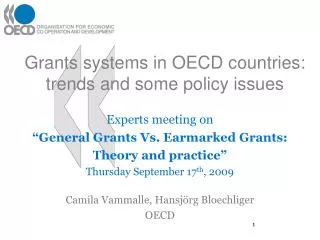
Grants systems in OECD countries: trends and some policy issues Experts meeting on “General Grants Vs. Earmarked Grants: Theory and practice” Thursday September 17th, 2009 Camila Vammalle, HansjörgBloechliger OECD
Share of transfers in total government expenditure (2005) Source: National Accounts
Change in the share of transfers in government expenditure (1995-2005) Source: National Accounts
Change in SCG expenditure to total government expenditure ratio (1995-2005) Source: National Accounts
Change in SCG tax revenues on total government tax revenues (1995-2005) Source: National Accounts
Composition of Grants (2006) Note: the first line corresponds to state averages, the second line to local averages. Source: OECD Fiscal Decentralisation Database
Change in the composition of grants (2000-2006) Note: the first line corresponds to state averages, the second line to local averages. Source: OECD Fiscal Decentralisation Database
Some policy issues (1/4) • Grants have an equalisation role Equalisation grants represent: • 2.3% of GDP • 4.8% of total government expenditure • 55% of total intergovernmental grants
Some policy issues (2/4) • Grants may reduce externalities • Spending or tax • Horizontal or vertical • Matching grants • Are these externalities overestimated?
Some policy issues (3/4) • Earmarked grants may be used to fund specific policies • Such as: risk sharing, experimentation, co-funding, addressing exceptional situations e.g.: Share of grants to SCGs in national stimulus packages:
Some policy issues (4/4) • But grants may have unintended side effects • Reducing SCG tax effort • Putting pressure on spending, deficits and debts • Thus need a skilful grant design and combining grants with complementary instruments