Understanding Memory Processes: Encoding, Storage, and Retrieval
100 likes | 227 Vues
This overview explores the fundamental processes of memory, including encoding, storage, and retrieval. Memory can be conceptualized through the lens of sensory input and the efficient organization of information to facilitate recognition and recall. Various techniques, such as chunking, elaborative rehearsal, and mnemonic devices, can enhance memory retention. It also touches upon the imperfections of memory, including forgetting and confabulation, and the impact of factors like decay, interference, and repression on our recollection. Understanding these processes can improve our ability to learn and recall information effectively.


Understanding Memory Processes: Encoding, Storage, and Retrieval
E N D
Presentation Transcript
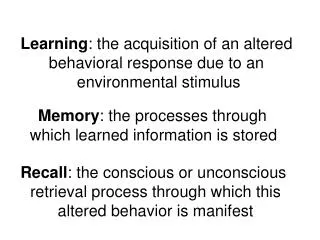
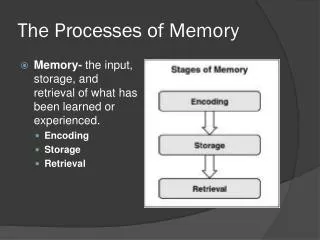
The Processes of Memory • Memory- the input, storage, and retrieval of what has been learned or experienced. • Encoding • Storage • Retrieval
Sensory Memory • The senses of sight and hearing( among other senses)
Journal Assignment: Responds should be between 5-7 sentences. • Describe examples of Chunking that you have used in the last week.
Retrieving Information Chapter 10.2
Recognition • Human memory is organized in such a way as to make recognition quite easy because people can say with a great deal of accuracy whether or not something is familiar to them or not. • The ability to recognize suggest that much more information is stored in memory than one might think. • The process of recognition provides insight into how information is stored in memory.
Recall • The ability to recognize information is the ability to recall that information; Recall- the active reconstruction of information. • Involves a person’s knowledge, attitude, and expectations; remembering is an active process guided by our experiences and environment.
Relearning and forgetting • Recognition and recall are types of declarative memory. • Relearning is both procedural and declarative memory. • Everyone experiences failure of memory from time to time; forgetting involves decay, interference, or repression. • Decay-fading away of memory over time. • Interference- blocking of a memory by previous or subsequent memories. • Repression- blocking memories of an embarrassing or frightening experience. • Amnesia- A loss of memory that may occurs after a blow to the head or as a result of brain damage.
Improving memory • Using repetition or maintenance rehearsal, can help you remember for a short period of time. • A more efficient way of remembering new information is the elaborative rehearsal, which allows you to relate new information to what you already know. • Mnemonic devices- techniques for using associations to memorize and retrieve information.