Understanding Subqueries in SQL: Types, Usage, and Examples
In SQL, subqueries are powerful tools used when a query relies on values not known beforehand. A subquery is a query nested within another query, enclosed in parentheses, and requires SELECT and FROM clauses. There are different types of subqueries, including Single-Row, Multiple-Row, Multiple-Column, Correlated, and Uncorrelated subqueries. Each type serves unique purposes, such as retrieving one or multiple values, and operates using various operators like IN, ANY, EXISTS, etc. This guide will delve into their functionality with practical examples.


Understanding Subqueries in SQL: Types, Usage, and Examples
E N D
Presentation Transcript
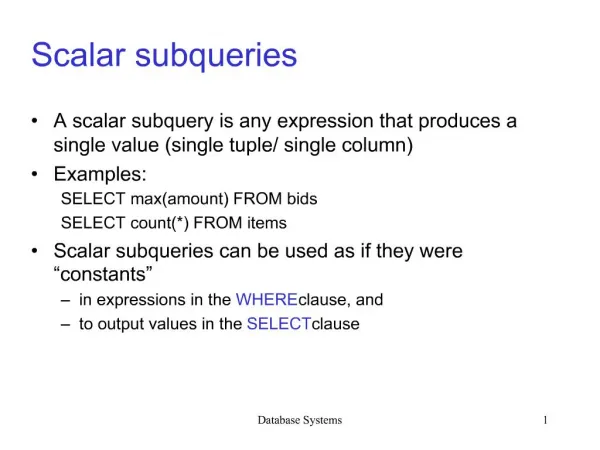
Subquery • Used when query is based on unknown value • A query nested inside another query • Requires SELECT and FROM clauses • Must be enclosed in parentheses • Place on right side of comparison operator
Single-Row Subquery Operators • Can only return one result to outer query • Operators include =, >, <, >=, <=, < >
Single-Row Subquery – In WHERE Clause Used for comparison against individual data
Single-Row Subquery – In SELECT Clause Replicates subquery value for each row displayed
Multiple-RowSubqueries • Return more than one row of results • Require use of IN, ANY, ALL, or EXISTS operators
ANY and ALL Operators Combine with arithmetic operators
EXISTS Operator Determines whether condition exists in subquery
Multiple-Column Subquery • Returns more than one column in results • Can return more than one row • Column list on left side of operator must be in parentheses • Uses IN operator for WHERE and HAVING clauses
Uncorrelated Subqueries • Processing sequence: • Inner query executed first • Result passed to outer query • Outer query executed
Correlated Subqueries • Inner query executed once for each row processed by outer query • Inner query references row contained in outer query
Nested Subqueries • Maximum 255 subqueries if nested in WHERE clause • No limit if nested in FROM clause • Innermost subquery resolved first, then next level, etc.
Nested Subquery Example Innermost resolved first (3), then second level (2), then outer query (1)