Redox Reactions.
This guide covers the fundamentals of redox reactions, emphasizing the processes of oxidation and reduction. Oxidation is characterized by oxygen gain and electron loss, while reduction involves oxygen loss and electron gain, altering the oxidation number. Key experiments such as burning magnesium and reactions between copper and silver nitrate provide practical insights. The definitions of oxidizing and reducing agents are clarified, alongside the importance of oxidation numbers in balancing chemical equations. Engage with real-world applications and examples to enhance your understanding.

Redox Reactions.
E N D
Presentation Transcript
Redox Reactions. Reduction Oxidation
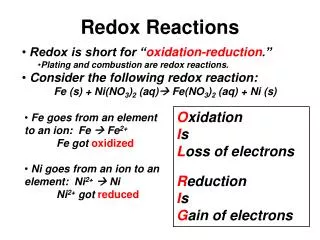
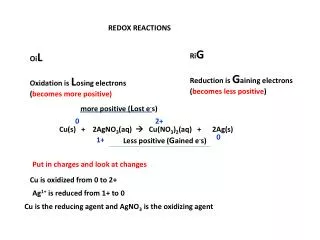
Oxidation and Reduction • Oxidation: • Gain of oxygen • Loss of electrons • Reduction: • Loss of oxygen • Gain of electrons Increase in oxidation number Decrease in oxidation number
4 Experiments: • Burning magnesium • Copper in silver nitrate solution • Chlorine solution and potassium iodide solution • Exploding hydrogen • Word equation • Balanced symbol equation
Oxidised – gains oxygen 2Mg(s) + O2(g) 2MgO(s) Must be a redox! Mg Mg2+ Oxidised – loss of e- +2e- Put the e- in. O O2-CHARGE OF A - = GAINED ELECTRONSCHARGE OF A += LOST ELECTRONS Reduced – gain of e- +2e-
Cu(s) + 2AgNO3(aq) Cu(NO3 )2(aq) + 2Ag(s) Complete the half-equations Oxidised? Reduced? Cu Cu2+ Oxidised – loss of e- +2e- Ag+ Ag Reduced – gain of e- +e-
reduction H2(g) + ½ O2(g)H2O(g) Reducing agent oxidation Oxidising agent Covalent! No H+ or OH- Need a new definition.
agents • Anoxidising agent isa substance that brings about oxidation(itself reduced) • example- hydrogen peroxide for bleaching hair • A reducing agent is a substance that brings about reduction.(itself oxidised)aa sulphur dioxide used to bleach straw
In terms of oxidation number • Oxidation: • Gain of oxygen • Loss of electrons • Reduction: • Loss of oxygen • Gain of electrons Increase in oxidation number Decrease in oxidation number
Oxidation Numbers- the seven rules • The oxidation number of an atom in an uncombined element is zero. E.g. Mg in Mg, O in O2. • The oxidation number of an ion of an element is the same as its charge. • O.N Br-= -1 • O.N Mg in Mg 2+ = +2 • ALKALI METALS= +1 • ALKALINE EARTH METALS=+2 • HALOGENS= -1
Oxidation Numbers • The oxidation numbers of atoms in a compound add up to zero. Oxidation state of C in CO2? x – 4 = 0 x = +4 Put the +!
Oxidation Numbers • The oxidation numbers of atoms in a compound add up to zero. Oxidation state of Mg in MgCl2? +2
Oxidation Numbers • The oxidation numbers of atoms in a compound add up to zero. Oxidation state of N in NH3? -3
Oxidation Numbers • The oxidation numbers of atoms in an ion add up to the charge on the ion. Oxidation state of S in SO42-? x – 8 = -2 x = +6
Oxidation Numbers • The oxidation numbers of atoms in an ion add up to the charge on the ion. Oxidation state of S in S2-? -2
Oxidation Numbers • The oxidation numbers of atoms in an ion add up to the charge on the ion. Oxidation state of N in NH4+? -3
Oxygen has a charge Oxygen has a charge of –2 EXCEPT in peroxides where the charge is –1 In the compound OF2 Where it has a value of +2. This is because F has a greater electronegative number than oxygen Hyrogen has a charge of +1 except in Metal hydrides where it has an O.N of –1 Metal Hydrides are ionic compounds NaH (+1)(-1) OXYGEN HYDROGEN
Halogens-assign charge of –1unless bonded to more electronegative elementCl2O(+1)2(-2)Cl= +1when writing formulas the most electronegative is placed second. • Halogen
H2(g) + ½ O2(g)H2O(g) Covalent! Need a new definition. No H+ or OH-
Oxidation: • Gain of oxygen • Loss of electrons • Reduction: • Loss of oxygen • Gain of electrons Increase in oxidation number Decrease in oxidation number
H2(g) + ½ O2(g)H2O(g) H Covalent! +1 0 O 0 -2 No H+ or OH- Need a new definition.
H2(g) + ½ O2(g)H2O(g) H +1 0 O 0 -2 Oxidised? Reduced? O – decrease in oxidation number H – increase in oxidation number
Balancing Redox Reactions • Using Oxidation Numbers balance the following equation. • Solution: • 1 assign oxidation number • 2. Note element that changes oxidation number. • 3.show the number of electrons lost and gained.
4.Work out ratio of oxidising agent to reducing agent. • 5.Balance remaining items by inspection method.
Worked Example MnO 4ֿ+Fe2+ +H+Mn2+ +Fe3+ +H2O (+7)4(-2) (+2)(+1) (+2) (+3) 2 (+1)(-2) MnO 4ֿ+Fe2+ +H+Mn2+ +Fe3+ +H2O (+7)4(-2) (+2)(+1) (+2) (+3) 2 (+1)(-2) ֿֿֿֿֿֿֿֿֿֿֿֿֿ GAINS 5 ELECTRONS LOSES 1 ELECTRON
Balance remaining items • 1MnO 4ֿ:5Fe2+ • 1MnO 4ֿ+5Fe 2+ +H+ 1Mn 2+ +5Fe3+ +H2O • 1MnO 4ֿ+5Fe2+ +8H+ 1Mn2+ +5Fe3+ +4H2O