Download
1 / 1
10 likes | 132 Vues
Understanding that every English sentence must include a subject and a finite verb can help prevent common writing errors. This guide highlights the three primary types of sentence fragments: phrases, disconnected compound predicates, and dependent clauses. By recognizing these structures, students can learn to form complete sentences. The provided examples illustrate how to test groups of words for completeness, ensuring clarity and coherence in writing. Master these concepts to enhance your writing skills and avoid common pitfalls.

E N D
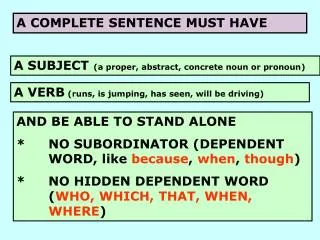
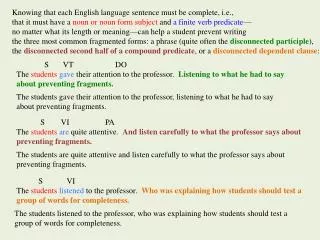
Knowing that each English language sentence must be complete, i.e., that it must have a noun or noun form subject and a finite verb predicate— no matter what its length or meaning—can help a student prevent writing the three most common fragmented forms: a phrase (quite often the disconnected participle), the disconnected second half of a compound predicate, or a disconnecteddependent clause: S VT DO The students gave their attention to the professor. Listening to what he had to say about preventing fragments. The students gave their attention to the professor, listening to what he had to say about preventing fragments. S VI PA The students are quite attentive. And listen carefully to what the professor says about preventing fragments. The students are quite attentive and listen carefully to what the professor says about preventing fragments. S VI The studentslistened to the professor. Who was explaining how students should test a group of words for completeness. The students listened to the professor, who was explaining how students should test a group of words for completeness.