Download
1 / 25
250 likes | 365 Vues
Chapter 27-28 delves into the consequences of the global depression and the Treaty of Versailles, which humiliated Germany and laid the groundwork for totalitarian regimes in Germany, Italy, and Japan. The chapter explores how these nations' aggressive actions culminated in a worldwide conflict involving major powers. It also examines the impact of the Great Depression and economic turmoil in Europe, the emergence of totalitarian leaders, and significant advancements in art and science during the interwar years, setting the stage for World War II and the ensuing Cold War.

E N D
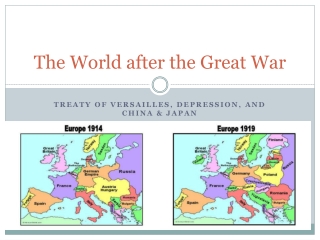
The World After the Great War WWII – Chapter 27-28
The devastating effects of worldwide depression and Treaty of Versailles led to rise of totalitarian regimes. Germany, Italy, and Japan aggression led to a major war involving most world powers. Following World War 2, two superpowers emerged leading to a Cold War.
Treaty of Versailles • Humiliated Germany by forcing to pay reparations, accept guilt, demilitarize, give up land and colonies • Reparations left Germany in debt.
Established League of Nations: • Organization of 42 nations who met to work out problems of world and avoid future, BUT…. • Had no military, so League could not enforce any of its laws • Did not include U.S. (voted against signing Treaty and League of Nations because they did not want to be involved in future European problems)
Countries Destroyed • Great Britain: • After the Great War, England was no longer the leading economic in the world; war caused large debt and had to borrow from the U.S.
France: • Most of the fighting during war took place in France and Germany; war destroyed villages, farms, and forests • Huge war debts meant that France could not rebuild quickly • Built Maginot Line between France and Germany to protect from future invasions
Italy: • Mad about Versailles Treaty because they did not get the land on Adriatic Coast • Unemployment grew in Italy after the war; led to riots and strikes
Germany: • New Weimar Republic created at Versailles, but seen as traitors; political stability and military coups threatened to overthrow of Weimar government • In 1922, Germany declared they could not pay reparations • Printed more money, led to massive inflation (money value decreased)
Russia: • By 1921, Russians had experienced the Great War, Russian Revolution, and a Civil War • 27 million Russians were killed as a result of these wars • Russia’s economy was broke
1919 - 1939 • Between WWI and WWII, the European countries that fought in the Great War were in debt and were slowly able to rebuild • The U.S. and Japan emerged from the Great War with wealth and prosperity because both had traded with Allies during the war
In USA, the 1920’s were a great time • New innovations were made in psychology, physics, art, and transportation: • Sigmund Freud created new ideas in psychology; believed that human mind had a conscious and subconscious thoughts that affect peoples’ behavior and mental illness
Albert Einstein created new ideas in physics (many disproved Newton’s ideas) believed light traveled at constant speed; believed space and time were not constant, but moved relative to other objects (Theory of Relativity) (E=mc2)
Pablo Picasso revolutionized art by creating cubism (abstract for of art using geometric shapes) • Salvador Dali utilized surrealism in art (using of dream-like images and unnatural objects); based on Freud’s ideas
Other technological innovations changed human life: • Cars became easy to buy and became a common purchase; paved highways built to connect places • First commercial air travel • Radio allowed people to hear news and entertainment
Economic Depression • In 1929, the U.S. stock market crashed • Investors were buying on margin (pay for only part of a stock), lenders called in loans which led to panic; banks collapsed; workers lost jobs (Great Depression in U.S.) • No money for investment in Europe; European banks collapsed; led to world-wide economic depression
Affects of Conditions • Bad conditions led to rise of totalitarism regimes in Europe • FASCISTS in Italy under Mussolini • NAZIS in Germany under Hitler • COMMUNISTS in Russia under Lenin and Stalin