Download

1 / 15
150 likes | 327 Vues
This document provides a thorough exploration of quadratic equations, including how to utilize the Quadratic Formula, the significance of the discriminant, and the nature of real and imaginary solutions. With examples demonstrating how to solve various quadratic equations and guidance on how to interpret the discriminant, this resource is designed to enhance your grasp of polynomial functions. Additionally, it covers operations with complex numbers, helping students navigate the realm of imaginary numbers effectively.

E N D
As you come in collect your Warm-Ups to be turned in. Place them on the seat of the desk. (you should have 10, be sure to write absent for the ones you were absent for; if you do not they will be counted as missing) Also grab a Project Rubric from the desk and you and your partner need to fill it out.
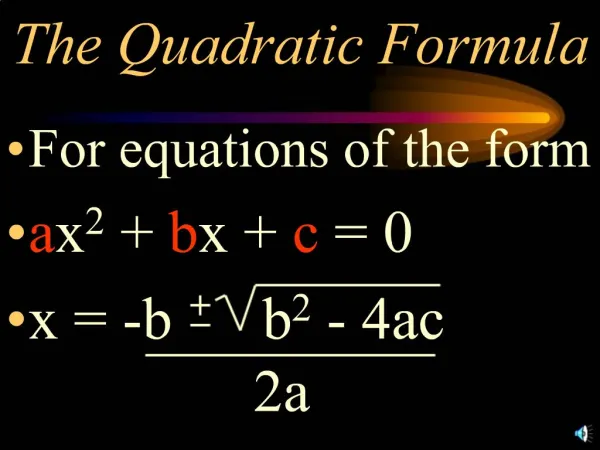
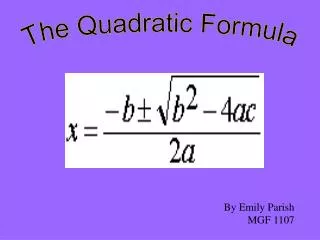
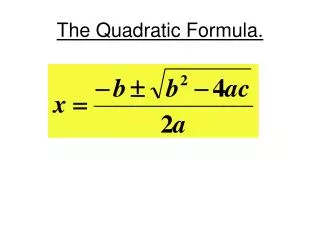
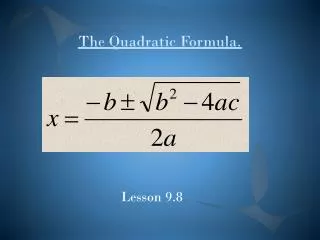
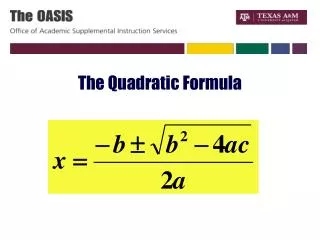
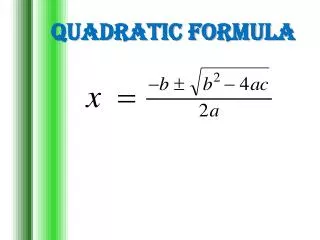
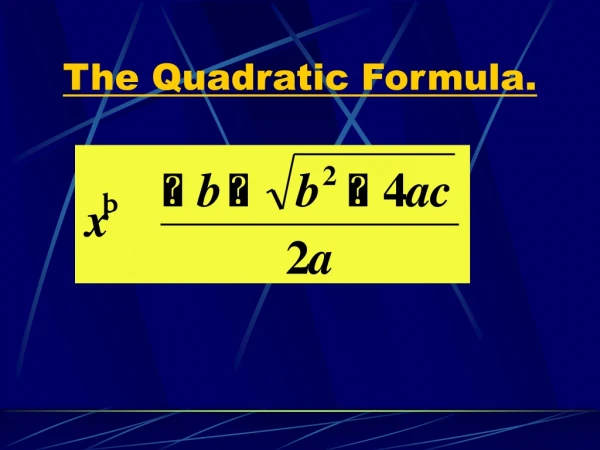
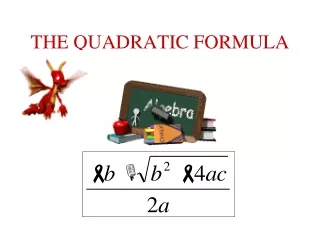
Quadratic Formula Quadratic Formula Song x equals negative b plus or minus, square root b squared minus four, a, c all over two, a
Solving Using the Quadratic Formula Example 1: x2 + 7x + 9 = 0 a = 1 b = 7 c = 9
Solving Using the Quadratic Formula Example 2: 5x2 + 16x – 6 = 3 a = 5 b = 16 c = -9
What the Discriminant Tells Us… • If it is positive then the formula will give 2 different answers • If it is equal to zero the formula will give only 1 answer • This answer is called a double root • If it is negative then the radical will be undefined for real numbers thus there will be no real zeros.
The Discriminant • When using the Quadratic Formula you will find that the value of b2 - 4ac is either positive, negative, or 0. • b2 - 4ac called the Discriminantof the quadratic equation.
Finding the Discriminant Find the Discriminant and determine the numbers of real solutions. Example 1: x2+ 5x + 8 = 0 How many real solutions does this quadratic have? b/c discriminant is negative there are no real solutions
Finding the Discriminant Find the Discriminant and determine the numbers of real solutions. Example 2: x2 – 7x = -10 How many real solutions does this quadratic have? b/c discriminant is positive there are 2 real solutions
Imaginary Numbers • What if the discriminant is negative? • When we put it into the Quadratic Formula can we take the square root of a negative number? • We call these imaginary numbers • An imaginary number is any number that be re written as:
Imaginary Numbers Example 1: Example 2:
Complex Numbers • A complex number is any number that can be written as a + bi, where a and b are real numbers; a is called the real part and b is called the imaginary part.
Operations with Complex Numbers • Find each sum or difference: • (-3 + 5i) + (7 – 6i) = • (-3 – 8i) – (-2 – 9i) =
Operations with Complex Numbers • Multiply: (2 + i)(-5 – 3i) =