Understanding the Water Cycle: Key Processes and Phases
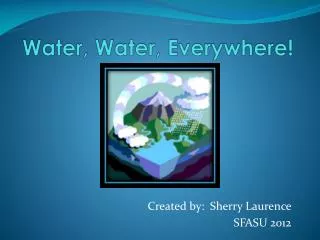
The water cycle is a continuous process that describes how water moves through various stages: evaporation, condensation, and precipitation. Solar energy heats ocean water, causing evaporation, while plants contribute moisture through transpiration. As water vapor rises and cools, it condenses into clouds. These clouds release precipitation in the form of rain or snow when droplets become heavy. Finally, water either runs off into oceans or evaporates back into the atmosphere, maintaining the cycle. Understanding these phases helps appreciate the importance of water in our environment.

Understanding the Water Cycle: Key Processes and Phases
E N D
Presentation Transcript
Objectives • Understand the major parts of the water cycle.
Water is continuously being moved through a repeated process Water Cycle 1 1b
(1a)Solar energy strikes ocean water, causing water molecules excite and turn into a gas • As it gets hotter it rises Evaporation 1a 1b
(1b) On land, plants lose moisture through small pores in their leaves. This is calledtranspiration. Water Cycle 1 1b
(2) The water vapor rises until the air is cool enough to transform it into tiny liquid droplets of water. • Clouds form Condensation 2 1a 1b
Name that cloud! 2. Cirrostratus 1. Cirrus 4. Altostratus 3. Cirrocumulus 9. Cumulo- nimbus 5. Altocumulus 8. Cumulus 6. Stratocumulus 7. Stratus
Precipitation • (3) If the droplets get large enough, gravity will cause them to fall to the ground. • It needs to hit the ground to be considered precipitation 2 3 1 1b
Water on the ground or in the ground will either evaporate again or eventually reach the ocean Runoff 2 3 1 1b