
Tomatoes
E N D
Presentation Transcript
Tomatoes Ian Hewett Horticultural Marketing Inspectorate United Kingdom
Tomatoes • This Standard applies to aubergines grown from Solanum lycopesicum to be supplied fresh to the consumer. • Tomatoes for industrial being excluded.
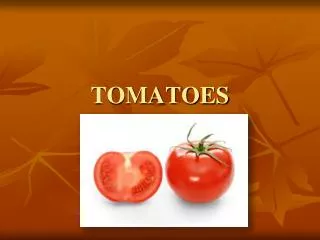
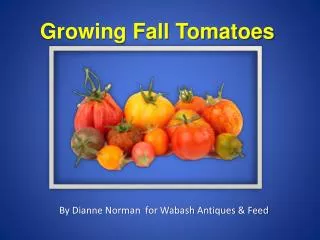
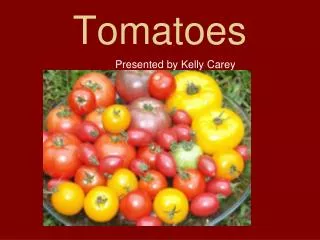
Tomatoes • Tomatoes may be classified into four commercial types: • "round", • "ribbed", • "oblong" or "elongated", • "cherry" tomatoes (including "cocktail" tomatoes).
Tomatoes • And be presented on the vine or loose:
Minimum Requirements • Intact, • Sound, produce affected by rotting or deterioration such as to make it unfit for consumption is excluded, Alternaria and Phytophthera
Minimum Requirements • clean, practically free of any visible foreign matter
Minimum Requirements • practically free from pests, • free from damage caused by pests affecting the flesh, Tuta absoluta
Minimum Requirements • fresh in appearance, • free of abnormal external moisture, • free of any foreign smell and/or taste.
Extra Class • Superior quality • Firm and characteristic of the variety • Have only very slight superficial defects
Skin Defects • Class I - Slight skin defects Class II - Skin defects allowed, provided the fruit is not seriously affected
Skin Defects • Skin defects seriously affecting the fruit • (the same fruit rotated) • Not acceptable
Skin Defects Botrytis Ghost spotting Class I – up to two small spots Class II – overall appearance not affected Out of grade – overall appearance affected
Skin Defects • Class I Class II Out of grade Stalk puncture
Healed Cracks Class I – None allowed Class II - Healed cracks not more than 3cm in length for round, ribbed or oblong tomatoes • Class II Out of grade
Healed Cracks • Fine cracking • Class II
Healed Cracks • Beef tomato • Healed crack limit 3cm • Class II
Cracks • Beef tomato • Out of grade - not healed
Defects in colouring Colour defects caused by virus: Class II Out of Grade Pepino mosaic virus
Sizing • Size can be determined by the maximum diameter (or size code), by weight or by count. • Sizing does not apply to trusses of tomatoes or to cherry tomatoes nor to Class II tomatoes. • Uniformity requirements apply to tomatoes packed in the same package and a size code can be applied to if desired.
Presentation • Uniformity - The ripeness and colouring in Extra Class and Class I must be practically uniform
Quality Tolerances • Extra Class: • 5% by number or weight not satisfying the requirements of the class but meeting those for Class I is allowed. Within this tolerance not more than 0.5% in total may consist of produce satisfying the requirements of Class II quality.
Quality Tolerances • Class I: • 10% by number or weight not satisfying the requirements of the class but meeting those for Class II is allowed. Within this tolerance not more than 1% in total may consist of produce satisfying neither the requirements of Class II quality nor the minimum requirements or of produce affected by decay. • For trusses of tomatoes 5% may be detached from the stalk.
Quality Tolerances • Class II: • 10% by number or weight satisfying neither the requirements for the class nor the minimum requirements is allowed. Within this tolerance not more than 2% in total may consist of produce affected by decay. • For trusses of tomatoes 10% may be detached from the stalk.
Labelling • Name/address of packer/dispatcher • ‘Tomatoes’, ‘Tomatoes on trusses’ • ‘Cherry’ or ‘Cocktail’ • Mixture of tomatoes • Country of origin • Class • Size min./max. diameter (if sized)