Download
1 / 32
320 likes | 436 Vues
This document provides a comprehensive analysis of single track efficiency measurements in high-energy physics experiments, focusing on data from TRG, TV, TCA+LIK, and MC methods at KINE levels. We explore methodologies for estimating efficiencies, including the merging of trigger and veto efficiencies, evaluating geometrical acceptances, and applying corrections based on empirical data and Monte Carlo simulations. Key findings highlight efficiencies that reach approximately 98%, with systematic errors maintained at minimal levels. These insights are pivotal for advancing particle tracking capabilities.

E N D
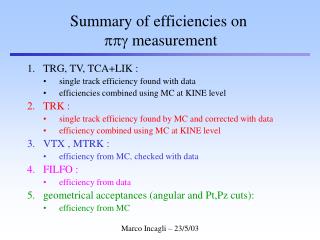
Summary of efficiencies onppg measurement • TRG, TV, TCA+LIK : • single track efficiency found with data • efficiencies combined using MC at KINE level • TRK : • single track efficiency found by MC and corrected with data • efficiency combined using MC at KINE level • VTX , MTRK : • efficiency from MC, checked with data • FILFO : • efficiency from data • geometrical acceptances (angular and Pt,Pz cuts): • efficiency from MC Marco Incagli – 23/5/03
1.1 – Trigger + Trigger Veto • The single particle TRG (and TV) efficiency is first obtained, then the information are combined using MC P0±(P1±)= probability that the p± fires 0(1) trigger sectors P0R(P1R) = prob. that the Rest of the event fires 0(1) trigger sectors PTRG = 1 - P0+ P0- P0R- P1+ P0- P0R- (-) - (R) • To evaluate the single particle TRG efficiency events with TV on(with the hardware prescale factor 5) + 1/5th of the events with TV offto be independent from the TV • TV efficiency is evaluated on triggered events, so what we find is e(TRG)•e(TV|TRG)
TRG + TV single track efficiency • To get the single particle efficiency • the track is associated to one or more clusters • the clusters are associated to trigger (TV) sectors • The first step is performed by extrapolating the TRK to the ECAL using the newextratom procedure (developed by T.S. and C.G.) and associating to TRK all clusters within a radius R=60cm • The second step is performed using the CTRG bank • A check of the dependence of the procedure from the R value has been performed
1 – TR+TV efficiency • The average efficiency starts to saturate at R60cm • The systematic error is at the 0.2 % level • A systematic error which is function of Q2 can be used
TRK efficiency • Two data samples are selected: p+p-p0: 2 prompt photons with p0 mass + a track which extrapolates back to IP connected to a cluster which satisfies the pion likelihood p+p-: 1 or 2 ‘prompt’ clusters ; one is associated with a track of p=490±5 MeV which satisfies the pion likelihood • Some cuts are applied to clean up the second sample. The following categories are selected: • monotracks • two tracks of the same sign • proton stars
Monotracks • They are characterized by a deposit of energy in one or two cells • Monotracks associated to clusters with 1 or 2 cells are removed from the sample Good events monotracks
Two tracks of Same Sign • They are removed if the minimum distance of LH-FH is larger than 100cm • (this is done to keep inefficiencies in which the tagging track is broken into two pieces)
Proton Stars • They are removed by cutting on the variable QTOT/Ntrk
Closing kinematically the event • The momentum of the candidate track is evaluated using the f-boost from Bhabhas, the photons after imposing the p0 mass and the tagging track extrapolated at IP • When a vertex exists in the event, then it is possible to check the goodness of the above procedure • The plots show that the error is symmetric and has m0 , s6 MeV • I take bins ofDp=25MeV which seems to be safe
Candidate track (TRK2) assignement • Once the event is selected the momentum components of TRK2 are evaluated(pxe,pye,pze) • All tracks of the events satisfying the cuts reported in the next transparency are compared with the tagging track • The track which minimizes the 2 defined below is the candidate track • A cut at 2<15 (it was 2<10) is applied 2distribution
Definition of candidate track • A candidate track must satisfy the following cuts: • Charge must be opposite wrt tagging track • First hit must have r<50cm • The point of closest approach(PCA) of backward track extrapolation must have rPCA<8cm and |zPCA|<7cm • c2 condition must be fulfilled
TRK efficiency data(p+p-p0+p+p-) vs MC(ppg) – 5slices in q btwn 40o and 90o DATA/MC MC DATA
TRK efficiency • Since the ratio data/MC is rather flat I use the MC track efficiency spectrum correcting it for the following percentage: (98.59+99.27)/2 = 98.93% • The systematic error of this procedure is estimated as half the maximum difference btwn the data/MC ratio: (99.27-98.59)/2=0.34%
TCA+Likelihood eff • The ratio data/MC is not flat , therefore MC cannot be used to measure TCA. This effect is expected, since TCA efficiency requires a detailed description of hadronic showers at low energy. • The TCA+LIK efficiency has been obtained by B.Valeriani by tagging the event with the p+ and looking at the p- and viceversa.
TCA+LIK efficiency 50o<q<90o The single track efficiency is at the level of 98%, except for the lowest q bin which is in the intersection between BAR and ECA The OR of the likelihood has an efficiency of ~100%, while for the AND the correct combination of efficiencies must be done 40o<q<50o 50o<q<90o 40o<q<50o
VTXEFF a module to select p+p-gevents • VTXEFF • A prompt photon having: • 29 < L/t < 32 cm/ns • E>20MeV ; r>100cm • Two tracks with: • opposite charge • rFH<50cm • rPCA<8cm • zPCA<7cm • Track 1 associated with a cluster which satisfies the pion likelihood
The selected sample has a large bck from p+p-p0, therefore the following cuts are applied: Mass(gg)<110MeV , >160MeV (if a second prompt photon exists) cos(Dqg)>0.9 (angle btwn photon and 2p system) |DEg|<20MeV Number of events Mpp2 (GeV2)
MC Data vtx efficiency vs Q2 (GeV2) vtx efficiency : (data-MC)/MC Vertex efficiency - LA • From the comparison data-MC at Large Angle, the systematics error on VTX is of the order of 1-2% • Note that LA spectrum essentially dies off at Q2=0.4GeV2 (MC), while data have a sizable fraction of p+p-p0 • More data could improve the significance of the comparison +2% -2%
Vertex efficiency - SA vs LA • Small angle events are back to back in f and they are on the same side in q • This causes the different VTX efficiency for the two categories • MC is used for SA eff.; LA used as benchmark • Systematics ~2%
Track Mass • The data track mass distribution has been compared with MC summing the signal + the two backgrounds ppp and mmg ; • The regions above and below Q2=0.5GeV2 have been fitted separately • .AND. of the likelihood, to suppress Bhabhas • Eg (prompt)<10MeV because of the cut in RPI stream p+p-p0 m+m-g
In the low Q2 region the following corrections have been applied: This procedure provides also the fraction of background events wrt signal; this value is used to scale the MC shape and to estimate the number of background events
The effect of the smearing+shifting on the track mass efficiency in the region of interest (>0.35) is at the per mille level
TRKMASS final efficiency efficiency Mpp2(GeV2)
FILFO efficiency Q2 (GeV2)
bclde (MeV) • If the QQ shape does not depend upon bclde, then:
Systematics - preliminary • TRG + TV : 0.2 % • TRK : 0.34 % • VTX : < 2 % • FILFO : < 1% • MTRK : 0.2 % (?) Systematic error dominated by VTX