
Understanding Thermal Energy: Heat Transfer, Specific Heat, and Thermal Expansion
E N D
Presentation Transcript
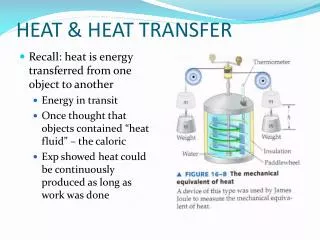
Thermal energy • The kinetic and potentialenergy of the randommicroscopic motion of molecules, atoms, ions, electrons & otherparticles • Heat • The thermal energytransferred from a hotter body to a colder body • .
calorie (cal) • Unit of heat • The amount of heatneeded to raise the temperature of 1 gram of water 1⁰ C 1 kcal = 1000 cal = 1 (food) Calorie • British Thermal Unit (BTU) • The thermal energytransferred from a hotter body to a colder body 1 BTU = 0.252kcal • .
example You mix 1.0kg water at 80⁰C with 1.0 kg water at 20⁰C. Whatis the final temperature Q = mcΔT Q80⁰C = Q20⁰C (mcΔT) 80⁰C = (mcΔT)20⁰C (1.0kg)(4187J/kg· ⁰C)(80-T) = (1.0kg)(4187J/kg· ⁰C)(T-20) 334960 – 4187 T = 4187 T – 83740 8374 T = 418700 T = 50⁰C
Mechanicalequivalent of heat • The conversion factor between calories and joules 1 cal = 4.187J • You need to convert thermal energy in calories to joules to relate to kineticenergy(1/2 mv2) or potentialenergy(mgy) • .
Thermal expansion • Expandingsolidsmaintain original shape • Expandingliquidsconform to the container • Linearexpansion ΔL = αLΔT L = length α = coefficient of liner expansion ΔT = temperature change
Example: The highest tower in the world is the steel radio mast of Warsaw Radio in Poland, which has a height if 646m. How much does its height increase between a cold winter day when the temperature is -35⁰C and a hot summer day when the temperature is +35 ⁰C ? ΔL = αLΔT = 12x10-6/ ⁰C x 646 x 70⁰C = 0.54m
Volume expansion ΔV= βVΔT L = length β = coefficient of liner expansion ΔT = temperature change cold hot Β = 3 α
convection • Heatisstored in a movingfluid and iscarriedfrom one place to another by the motion of thisfluid • radiation ΔL = αLΔT L = length α = coefficient of liner expansion ΔT = temperature change
radiation • The heatiscarriedfrom one place to another by electromagneticwaves RADIATION
SpecificHeat of a Gas MolarSpecificHeatat a constant volume the heatabsorbedduring the change of state Q = nCvΔT Q = amount of heat required n = number of moles Cv = specific heat at a constant volume ΔT = Change in temperature MolarSpecificHeatat a constant pressure the heatabsorbedduring the change of state Q = nCpΔT Cp= specific heat at a constant pressure
Q = nCv ΔT • with a small amount of heat, the energy must match • dQ = dE so nCv ΔT = dE • The force of the gas on the piston is pA and the work done by the gas is dW = Fdx • so dW = pAdx Adx is the small change dV of volume • dW = pdV • dQ = dE+ dW = dE + pdV or nCp dT = dE +pdV • nCp dT = nCV dT + pdV Ideal gas Law pdV = nRdT • nCp dT = nCV dT + nRdT Cp = CV + R • R = 8.31 J/K·mol or 1.99 cal/K·mol