
The Survival of Mars Meteorites: Insights from the Linear Accelerator Experiment
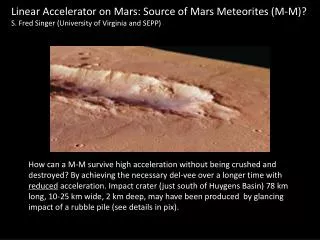
This research explores how Mars meteorites, referred to as M-Ms, can withstand high acceleration without disintegration. By using the Linear Accelerator at the University of Virginia, Fred Singer examines the relationship between del-vee (velocity change) and the duration of acceleration, emphasizing that lower accelerations over more extended periods can preserve the integrity of these meteorites. The study also discusses a significant impact crater near Huygens Basin, suggesting it may have formed from a glancing collision with a rubble pile, underscoring the complexities of Martian geology.

The Survival of Mars Meteorites: Insights from the Linear Accelerator Experiment
E N D
Presentation Transcript
Linear Accelerator on Mars: Source of Mars Meteorites (M-M)?S. Fred Singer (University of Virginia and SEPP) How can a M-M survive high acceleration without being crushed and destroyed? By achieving the necessary del-vee over a longer time with reduced acceleration. Impact crater (just south of Huygens Basin) 78 km long, 10-25 km wide, 2 km deep, may have been produced by glancing impact of a rubble pile (see details in pix).