Understanding malloc in the Linux Kernel: Insights and Mechanisms
150 likes | 297 Vues
This article delves into the workings of the `malloc()` function from the Linux Kernel's perspective, detailing how memory allocation is managed in process address spaces. It explores the heap's role in memory regions, the interaction with page tables, and how system calls like `brk()` and `sbrk()` manage memory allocation during runtime. We also discuss page faults, demand paging, and the implications of non-contiguous memory areas. Gain a deeper understanding of the algorithms behind memory allocation and their practical implications in Linux.


Understanding malloc in the Linux Kernel: Insights and Mechanisms
E N D
Presentation Transcript
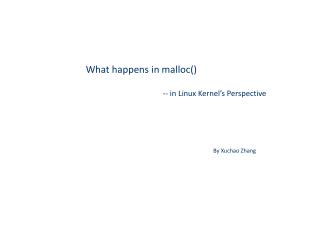
What happens in malloc() -- in Linux Kernel’s Perspective By Xuchao Zhang
void* p = malloc(size); • Function in c lib • Where? Heap • How? • (1) in kernel (2) algo for malloc What’s malloc()
1. Process Address space Abstraction of memory for a process task_struct -> mm_struct 2. memory region A resource to implement memory allocation (allocate page frame when use) Heap in Linux Kernel
2. memory region (continue..) Q: what’s the relationship with page table? Example: file mapping. //TODO: file mapping Heap in Linux Kernel
3. Heap in Process Address Space one of memory region. Heap in Linux Kernel
4. brk(), sbrk() sys_brk(addr) – system call equals to: do_mmap(NULL, oldbrk, newbrk-oldbrk, PROT_READ|PROT_WRITE|PROT_EXEC, MAP_FIXED|MAP_PRIVATE, 0); malloc() call brk() to get new heap memory. So malloc()’s job is to organize the heap memory region. See Algo of malloc. Heap in Linux Kernel Question: malloc() call brk() to allocate new heap memory, so when to allocate physical memory? Let’s see what happens in following statement: int* p = (int*)malloc(4); *p = 4; // what happens here.
When happens? • present = 0 • read/write violation Page Fault Exception Handler
1. demand page • present = 0 • (1) pte = 1 never accessed before • 1) vma->vm_ops->nopage != NULL : file mapping, call no page. • 2) vma->vm_ops->nopage != NULL : get a new page frame by do_anonymous_page() • Do anonymous • write request && read request • (2) pte = 0 swap out to disk • //TODO • int* p = (int*)malloc(4); • *p = 4; // what happens here. • 2. copy on write* • present = 1 Read/Write=0(write protection) • 3. Noncontiguous memory area address* • swap_pg_dir: kernel’s page directory • 4. User mode stack* • grow down Page Fault Exception Handler (continue)
demand page • present = 0 • (1) pte = 1 never accessed before • 1) vma->vm_ops->nopage != NULL : file mapping, call no page. //TODO • 2) vma->vm_ops->nopage != NULL : get a new page frame by do_anonymous_page() • do_anonymous_page() • 1. write request • alloc_page() memset to 0 //sample here. • 2. read request • use zero page instead of allocating new page frame. • (2) pte = 0 swap out to disk • //TODO • int* p = (int*)malloc(4); • *p = 4; // what happens here. Page Fault Exception Handler (continue)
Source Code Source Code address space Malloc Large chunk mmap()
1. File Mapping
1. Swap out
1 A very simple malloc() implementation
http://book.csdn.net/bookfiles/228/ Doug Lea ’s malloc()
1 Comparison of memory allocation strategies