Quantitative Analysis of Microbial Communities in Magoura Cave Rock Paintings, Bulgaria
This research investigates the microbial diversity associated with the rock paintings in Magoura Cave, Bulgaria. With an impressive display of ancient art influenced by bat guano, the study characterizes various microbial communities, focusing on dominant groups. Eleven different physiological groups were cultivated and quantitatively analyzed. Results reveal that the majority of microbiota includes facultative psychrophiles and spore-forming bacteria, with a stable community potentially affecting the preservation of the paintings. This emphasizes the need for ongoing monitoring of these microbial populations.

Quantitative Analysis of Microbial Communities in Magoura Cave Rock Paintings, Bulgaria
E N D
Presentation Transcript
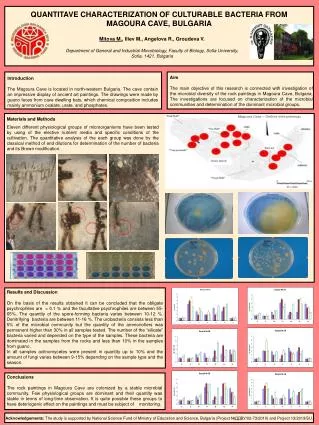
QUANTITAVE CHARACTERIZATION OF CULTURABLE BACTERIA FROM MAGOURA CAVE, BULGARIA Mitova M., Iliev M., Angelova R., Groudeva V. Department of General and Industrial Microbiology, Faculty of Biology, Sofia University, Sofia, 1421, Bulgaria Aim The main objective of this research is connected with investigation of the microbial diversity of the rock paintings in Magoura Cave, Bulgaria. The investigations are focused on characterization of the microbial communities and determination of the dominant microbial groups. Introduction The Magoura Cave is located in north-western Bulgaria. The cave contain an impressive display of ancient art paintings. The drawings were made by guano feces from cave dwelling bats, which chemical composition includes mainly ammonium oxalate, urate, and phosphates. Materials and Methods Eleven different physiological groups of microorganisms have been tested by using of the elective nutrient media and specific conditions of the cultivation. The quantitative analysis of the each group was done by the classical method of end dilutions for determination of the number of bacteria and its Brown modification. Results and Discussion On the basis of the results obtained it can be concluded that the obligate psychrophiles are < 0.1 % and the facultative psychrophiles are between 55-65%. The quantity of the spore-forming bacteria varies between 10-12 %. Denitrifying bacteria are between 11-16 %. The urobacteria consists less than 5% of the microbial community but the quantity of the ammonofiers was permanent higher than 30% in all samples tested. The number of the “silicate” bacteria varied and depended on the type of the samples. These bacteria are dominated in the samples from the rocks and less than 10% in the samples from guano. In all samples actinomycetes were present in quantity up to 10% and the amount of fungi varies between 9-15% depending on the sample type and the season. Conclusions The rock paintings in Magoura Cave are colonized by a stable microbial community. Few physiological groups are dominant and their quantity was stable in terms of long-time observation. It is quite possible these groups to have deteriogenic effect on the paintingsand must be subject of monitoring. Acknowledgements: The study is supported by National Science Fund of Ministry of Education and Science, Bulgaria (Project №ДДВУ/02-73/2010) and Project 13/2013/SU.