
Computerized Oculomotor Vision Screening for Binocular Vision Assessment in Military Populations
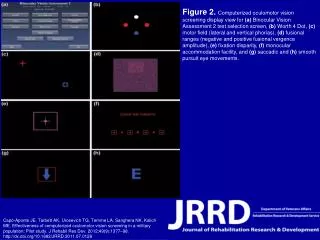
This study investigates the effectiveness of computerized oculomotor vision screening in assessing binocular vision in a military population. The screening display features components such as a test selection screen, Worth 4 Dot test, motor field measurement, and assessment of fusional ranges, fixation disparity, monocular accommodation facility, and eye movements (saccadic and smooth pursuit). Findings suggest that this advanced screening method can enhance vision assessment efficiency and is crucial for determining visual capabilities in military personnel.

Computerized Oculomotor Vision Screening for Binocular Vision Assessment in Military Populations
E N D
Presentation Transcript
Figure 2. Computerized oculomotor vision screening display view for (a) Binocular Vision Assessment 2 test selection screen, (b) Worth 4 Dot, (c) motor field (lateral and vertical phorias), (d) fusional ranges (negative and positive fusional vergence amplitude), (e) fixation disparity, (f) monocular accommodation facility, and (g) saccadic and (h) smooth pursuit eye movements. Capó-Aponte JE, Tarbett AK, Urosevich TG, Temme LA, Sanghera NK, Kalich ME. Effectiveness of computerized oculomotor vision screening in a military population: Pilot study. J Rehabil Res Dev. 2012;49(9):1377–98.http://dx.doi.org/10.1682/JRRD.2011.07.0128
