Investigating the Role of FASN Gene Expression in Insulin Regulation and Cellular Growth Inhibition
This study examines the expression of the FASN gene in relation to insulin and glucose signaling pathways using supplemental figures. We analyze FASN mRNA levels in adipose tissues of different models, including adipocytes and tumor cells, and assess the effects of treatments like metformin and calorie deprivation on cell growth inhibition and maturation. The research aims to provide insights into the AMPK pathway and protein synthesis regulation, highlighting the importance of FASN in metabolic control and chronic energy status.

Investigating the Role of FASN Gene Expression in Insulin Regulation and Cellular Growth Inhibition
E N D
Presentation Transcript
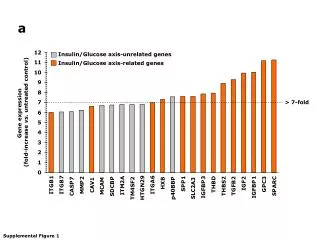
a Insulin/Glucose axis-unrelated genes Insulin/Glucose axis-related genes > 7-fold Gene expression (fold-increase vs. untreated control) Supplemental Figure 1
FASN/mRNA PPIA mRNA in OM adipose tissue Fasting glucose (mg/dl) b Supplemental Figure 1
a Adipocytes Tumor cells Control Day 0 DNA FASN DNA FASN 3T3-L1 MCF-7 CELL GROWTH INHIBITION ADIPOCYTE MATURATION FASN down-regulation FASN up-regulation 3T3-L1 MCF-7 DNA FASN DNA FASN Day 9 Metformin Supplemental Figure 2
b + + ? EXERCISE CALORIE DEPRIVATION AMP METFORMIN ATP THIAZOLIDINEDIONES Other AMPK activators AMPK LOW-ENERGY STATUS INACTIVE TSC1 TSC2 P P ACUTE EFFECT AMPK ACTIVE P P mTOR ACACA activity CHRONIC EFFECTS 4E-BP1 S6K1 Protein synthesis initiation FASN gene transcription FASN mRNA FASN mRNA translation FASN promoter Supplemental Figure 2