Understanding Trigonometry: Angles, Radians, and Trigonometric Functions
This comprehensive guide on trigonometry covers essential concepts such as definitions of angles, terminal and initial rays, and coterminal angles. It explains radian measures and the relationship between degrees and radians, alongside visualizing these concepts on the unit circle. Learn about basic trigonometric ratios - sine, cosine, and tangent - including reciprocal functions. Explore graphing techniques for trig functions, analyze reference angles in various quadrants, and discover how to convert between degree and radian measures effectively.

Understanding Trigonometry: Angles, Radians, and Trigonometric Functions
E N D
Presentation Transcript
Definition of an angle Terminal Ray + Counter clockwise Initial Ray -clockwise Terminal Ray
Coterminal angles – angles with a common terminal ray Terminal Ray Initial Ray
Coterminal angles – angles with a common terminal ray Terminal Ray Initial Ray
Definition of Radians C= 2πr C= 2π radii C= 2π radians 360o = 2πradians r 180o = π radians 1 Radian 57.3 o r
Unit Circle – Radian Measure Degrees
Converting Degrees ↔ Radians Converts degrees to Radians Recall Converts Radians to degrees more examples
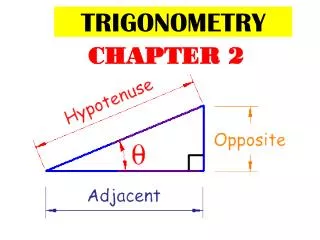
Basic ratio definitions Hypotenuse Opposite Leg Reference Angle θ Adjacent Leg
Circle Trigonometry Definitions (x, y) Radius = r Opposite Leg = y Adjacent Leg = x reciprocal functions
Unit - Circle Trigonometry Definitions (x, y) Radius = 1 Opposite Leg = y Adjacent Leg = x 1
Unit Circle – Trig Ratios sin cos tan (+, +) (-, +) (+, -) (-, -) Skip π/4’s Reference Angles
Unit Circle – Trig Ratios sin cos tan (-, +) (+, +) (-, -) (+, -)
Unit Circle – Trig Ratios sin cos tan (-, +) (+, +) (0 , 1) Quadrant Angles (-1, 0) (1, 0) sin cos tan 0 /2π 0 1 0 0 Ø 1 (0, -1) (-, -) (+, -) 0 0 -1 Ø -1 0 View π/4’s
Unit Circle – Radian Measure sin cos tan (-, +) (+, +) Quadrant Angles sin cos tan 1 0 /2π 0 1 0 0 Ø 1 (-, -) (+, -) 0 0 -1 Ø Degrees -1 0
A unit circle is a circle with a radius of 1 unit. For every point P(x, y) on the unit circle, the value of r is 1. Therefore, for an angle θin the standard position:
Graphing Trig Functions f ( x ) = A sin bx
Amplitude is the height of graph measured from middle of the wave. Amplitude Center of wave f ( x ) = A sin bx
f ( x ) = cos x A = ½ , half as tall
f ( x ) = sin x A = 2, twice as tall
Period of graph is distance along horizontal axis for graph to repeat (length of one cycle) f ( x ) = A sin bx
f ( x ) = sin x B = ½ , period is 4π
f ( x ) = cos x B = 2, period is π
The End Trigonometry Hipparchus, Menelaus, Ptolemy Special Right Triangles The Pythagoreans Graphs Rene’ DesCartes
Reference Angle Calculation 2nd Quadrant Angles 3rd Quadrant Angles 4th Quadrant Angles Return
Unit Circle – Degree Measure 90 120 60 45 135 150 30 180 0/360 330 210 225 315 300 240 270 Return
Unit Circle – Degree Measure sin cos tan 30 90 (-, +) (+, +) 45 120 60 45 135 60 150 30 Quadrant Angles 180 0/360 sin cos tan 1 330 210 0/360 0 1 0 225 315 0 Ø 90 1 300 240 (-, -) (+, -) 0 180 0 -1 270 Ø Return 270 -1 0
Ex. # 3 Ex. # 4 Ex. # 5 Ex. # 6 return
Circle Trigonometry Definitions – Reciprocal Functions (x, y) Radius = r Opposite Leg = y Adjacent Leg = x return