Overview of the Immune System
100 likes | 248 Vues
This overview highlights the significance of the immune system, focusing on its role in protecting the body against pathogens and altered self-cells, such as cancer. It discusses the mechanisms of defense, differentiating between innate and adaptive immune responses. The innate response is consistent with repeated exposure to pathogens, while the adaptive response develops over time, offering quicker protection upon re-exposure. Understanding both the beneficial and detrimental effects of the immune system is critical for appreciating its balance in protecting against infections and potential self-damage.


Overview of the Immune System
E N D
Presentation Transcript
Overview of the Immune System Jennifer Nyland, PhD Office: Bldg #1, Room B10 Phone: 733-1586 Email: jnyland@uscmed.sc.edu
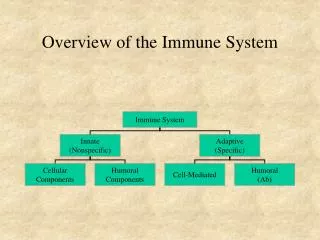
Teaching objectives • Recognize the significance of the immune system • What is the role/purpose? • What are the mechanisms of protection? • Distinguish between the innate and adaptive immune response • What are the key features differentiating these two arms of the immune system?
Overview of the immune system • Purpose: • Protection from pathogens • Intracellular (viruses, some bacteria and parasites) • Extracellular (most bacteria, fungi, and parasites) • Eliminate modified or altered “self” • Cancer or transformed cells • Methods of defense: mechanical, cellular, humoral
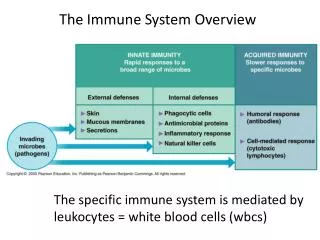
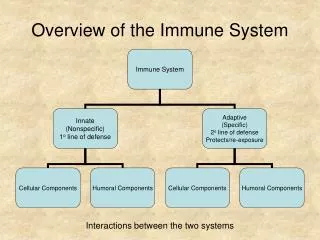
Phases of the immune response • Pathogen recognition • Innate response is the same to repeated exposures of the same pathogen • Adaptive response matures over time; repeated exposure leads to faster response • Pathogen removal • Early response: innate • Later response: lymphocytes generate adaptive immune response and memory
Effects of the immune system • Beneficial • Protection from invader • Elimination of altered self • Detrimental • Inflammation (local damage and discomfort) • Damage to self (hypersensitivity or autoimmunity)
Balance Disease = (bolus of infection x virulence)/immunity infection immunity