CORONAL HEATING
This document outlines the complexities of coronal heating, focusing on observations made during various solar phenomena and their implications. Key concepts include the dynamics of coronal loops and waves, the role of magnetic reconnection, and the impact of magnetic carpet models on solar output. The text analyzes observational data from instruments like Hinode and TRACE, exploring how energy is transported within the corona and the implications for solar activity. The results suggest that magnetic reconnection plays a central role in heating the corona through various mechanisms.

CORONAL HEATING
E N D
Presentation Transcript
CORONAL HEATING (Space Climate School, Saariselka, March, 2009)Eric Priest (St Andrews)
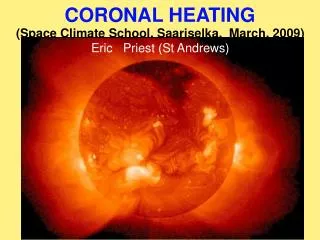
Skylab -- X-ray telescope Coronal holes -- loops -- X-ray bright points
Yohkoh(5 arcsec) A dynamic magnetic world - subtle interactions B & plasma
Hinode (1 arcsec) Stunning detail on structure & dynamics (see Tsuneta) How is corona heated?
Waves or reconnection? - Space Obsns: • Low-freq. wavesin loops [TRACE]-too weak to heat • High-freq. waves [UVCS]-- ?? heat outer corona • Hinode -- Chromospheric Spicules swaying (straw, prairy) Hansteen, Suematsu --?? Solar wind/ coronal heating
2. Reconnection - most likely in low corona Quiet Sun: [XRT on Hinode, Tsuneta, golub] Many brightenings X-ray bright points - above emerging and/or cancelling fields in photosphere [30-sec cadence, 12-hour duration]
Hinode XRT - active region (Schmeltz et al, 2009) Observations inside white region Differential emission measure Normal active region emission at 3 MK Plus peak at 20 MK (?nanoflares)
Parker’s classical Nanoflare Model by braiding (1972) Initial B uniform / motions braiding
Numerical Experiment(Galsgaard) Braiding --> Current sheets grow --> turb. recon.
3. Coronal Tectonics Model (development of Parker’s model) 3.1 Effect “Magnetic Carpet” Magnetic sources in surface are concentrated
Flux Sources Highly Dynamic Magnetogram movie (white +ve , black -ve) • Flux emerges ... cancels • Reprocessed very quickly (14 hrs !!!)
Many Sources--> Corona has Complex Topology In 2D -- Separatrix curves In 3D -- Separatrix surfaces
In 2D,reconnection at X In 3D,reconnection atseparator In complex fields we form the SKELETON-- set separatrices
3.3 “Simple” binary interaction of 2 photospheric sources (Haynes et al) - and + sources in overlying B. • Separatrix surfaces. Move sources & watch Interaction • flux tube joining sources Separator
2 separators 5separators Cross-sections of Separatrix Surfaces Separatrix surfaces(positive, negative) & Separators ( ) Number of separators: X
Life of Magnetic Flux in Surface • (a) 50%? flux in Quiet Sun emerges as ephemeral regions [1 per 8 hrs per supergran, 3 x 10¹⁹ Mx] • (b) Each pole migrates to boundary (4 hours), fragments --> 10 "network elements" (3x10¹⁸ Mx) • (c) -- move along boundary (0.1 km/s) -- cancel
From observed magnetograms - construct coronal field lines • each source • connects to 8 others Time for all field lines to reconnect only 1.5 hours (Close et al) • much more tectonics heating low down where field is more complex than higher up
Coronal Tectonics Model (updated version of Parker nanoflare/topological dissipation) • (Priest, Heyvaerts & Title) • Each "Loop" --> surface in many sources • Flux from each source separated by separatrix surfaces • As sources move --> J sheets on separatrices & separators --> Reconnect --> Heat • Corona filled w. myriads of J sheets, heatingimpulsively
Fundamental Flux Units not Network Elements • Intense tubes (B -- 1200 G, 100 km, 3 x 10¹⁷ Mx) • Each network element -- 10 intense tubes • Single ephemeral region (XBP) -- 100 sources 800 seprs, 1600 sepces • Each TRACE • Loop -- 10 finer loops 80 seprs, 160 sepces
TRACE Loop Reaches to surface in many footpoints. Separatrices form web in corona
Corona - Myriads Different Loops Each flux element --> many neighbours But in practice each source has 8 connections
Results • Heating uniform along separatrix • Elementary (sub-telc) tube heated uniformly • But 95% photc. flux closes low down in carpet • -- remaining 5% forms large-scale connections • --> Carpet heated more than large-scale corona • So unresolved observations of coronal loops • --> Enhanced heat near feet in carpet • --> Upper parts large-scale loops heated uniformly & less strongly
4. If reconnection heats coronaat many sheets, 1. How does energy spread out ? -- conduction along B -- reconnection jets -- waves across B 2.If reconnection time-dependent, how much energy liberated locally/globally? Simple model problem [Longcope & Priest]
Magnetic field of Current Sheet in X At large r,B = B0 + B1 (line current), Lots of energy far from CS
Suppose sheet reconnects Current (I) dissipates Local process but has global consequences: Decrease I --> B must change at large distances How ??
Model for effect of reconnection Linearize about X-point B0 : Assume B1 @ t=0 is due to current sheet current diffuses i.e. reconnection is “turned on”
(r) I Expect: I0 r r D Combine equations: Put = twice current enclosed in r wave diffusion
I0 R I0 r wave diffusion (i)Large r (wave) limit:when >> I(R,t)=I0-F(t-R) (ii)Small r (diffusive) limit: NB --> 0 at origin as t increases
Numerical Solution I(r) Wave solution R Transition: diffusive to wave solution Diffusive solution t
Sheath of Current propagates out In wake of sheath a flow, assocd with But flow near X does not disappear -- it slowly increases ! EV increasing t
At large t Resolving the Paradox - 3rd regime = Advection diffusion Peak in j remains at X and produces a steady E (indep of )
5. Summary Coronal tectonics -- updated version of Parker braiding Response to enhanced in current sheet (CS) during coronal tectonics: (i) Diffusion spreads CS out (ii) Wave carries current out at vA - as sheath (iii) Peak in j at X remains --> steady E independent of i.e. fast • Most magnetic energy is converted into • kinetic energy in wave -- • may later dissipate. • Coronal heating -- reconnection + wave