Implementation of STFT: Direct, FFT-Based, Recursive, and Chirp-Z Transform Methods
This document covers the implementation of Short-Time Fourier Transform (STFT) using various methods. It delves into direct implementation, FFT-based methods, recursive methods, and Chirp-Z transformation. Key constraints such as sampling intervals and bandwidth are discussed, along with the complexity associated with each method. Emphasis is placed on practical applications using MATLAB to compute STFT, alongside advantages and disadvantages of the different approaches. The text provides a comprehensive guide for signal processing enthusiasts aiming to understand STFT implementations.

Implementation of STFT: Direct, FFT-Based, Recursive, and Chirp-Z Transform Methods
E N D
Presentation Transcript
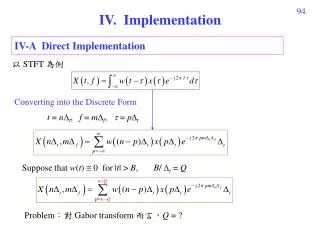
IV. Implementation IV-A Direct Implementation 以 STFT 為例 Converting into the Discrete Form t = nt, f = mf, = pt Suppose that w(t) 0 for |t| > B, B/ t = Q Problem:對 Gabor transform 而言,Q = ?
Constraint for t(The only constraint for the direct implementation method) To avoid the aliasing effect, t < 1/2, is the bandwidth of ? There is no constraint for fwhen using the direct implementation method.
Four Implementation Methods (1) Direct implementation Complexity: 假設 t-axis 有 T個 sampling points, f-axis 有 F個 sampling points (2) FFT-based method Complexity: (3) FFT-based method with recursive formula Complexity: (4) Chirp-Z transform method Complexity:
IV-B FFT-Based Method Constraints: tf = 1/N, N = 1/(tf) ≧ 2Q +1: (tf 是整數的倒數) Note that the input of the FFT has less than N points (others are set to zero). Standard form of the DFT , q = p(nQ) → p = (nQ)+q where for 0 q 2Q, x1(q) = 0 for 2Q < q < N.
注意: (1) 可以使用 Matlab 的 FFT 指令來計算 (2) 對每一個 n都要計算一次
假設 t = n0t, (n0+1) t, (n0+2) t, ……, (n0+T-1)t f = m0 f, (m0+1) f, (m0+2) f, ……, (m0+F-1)f Step 1: Calculate n0, m0, T, F, N, Q Step 2: n = n0 Step 3: Determine x1(q) Step 4: X1(m) = FFT[x1(q)] Step 5: Convert X1(m) into X( nt, mf) Step 6: Set n = n+1 and return to Step 3 until n = n0+T-1. page 97
IV-C Recursive Method • A very fast way for implementing the rec-STFT • (n 和n1有recursive的關係) • (1) Calculate X(min(n)t, mf) by the N-point FFT • , n0= min(n), • for q2Q, x1(q) = 0 for q > 2Q • (2) Applying the recursive formula to calculate X(nt, mf), • n = n0 +1~ max(n) T點 F點
IV-DChirp Z Transform For the STFT Step 1 multiplication Step 2 convolution Step 3 multiplication
Step 1 n-Q p n+Q Step 2 Step 3 Step 2 在計算上,需要用到 linear convolution 的技巧 Question: Step 2 要用多少點的 DFT?
Illustration for the Question on Page 102 Case 1 When length(x[n]) = N, length( h[n]) = K, N and K are finite, length(y[n]) = N+K1, Using the (N+K1)-point DFTs (學信號處理的人一定要知道的常識) Case 2 x[n] has finite length but h[n] has infinite length ????
Case 2 x[n] has finite length but h[n] has infinite length x[n] 的範圍為 n [n1, n2],範圍大小為 N = n2− n1 + 1 h[n] 無限長 y[n] 每一點都有值 (範圍無限大) 但我們只想求出 y[n] 的其中一段 希望算出的 y[n] 的範圍為 n [m1, m2],範圍大小為 M = m2 − m1 + 1 h[n] 的範圍 ? 要用多少點的 FFT ?
改寫成 當n = m1 當n = m2
m1− n2 m1− n1 m1−n2+1 m1−n1+1 m1−n2+2 m1−n1+2 n = m1時n− s的範圍 n = m1 +1 時n− s的範圍 m2−n2 m2−n1 n = m1 +2 時n− s的範圍 n = m2時n− s的範圍 有用到的 h[k] 的範圍:k [m1− n2, m2− n1]
所以,有用到的 h[k] 的範圍是 k [m1 −n2 , m2 −n1 ] 範圍大小為 m2 − n1 − m1 + n2 + 1 = N + M − 1 FFT implementation for Case 3 for n = 0, 1, 2, … , N−1 for n = N, N + 1, N + 2, ……, L −1 L = N + M − 1 for n = 0, 1, 2, … , L−1 for n = m1, m1+1, m1+2, … , m2
IV-E Advantages and Disadvantages of the Four Methods (A) Direct Implementation Advantage: simple, flexible Disadvantage : higher complexity (B) DFT-Based Method Advantage : lower complexity Disadvantage : with some constraints (C) Recursive Method Advantage : Disadvantage : (D) Chirp Z Transform Advantage : Disadvantage :
IV-F Unbalanced Sampling for STFT and WDF 將 pages 94 and 97 的方法作修正 where t = nt, f = mf, = p, B = Q S = t/ 註:(sampling interval for the input signal) t(sampling interval for the output t-axis) can be different. However, it is better that S = t/ is an integer. (假設 w(t) 0 for |t| > B),
When (1) f= 1/N, (2) N = 1/(f) > 2Q +1: (f只要是整數的倒數即可) (3) < 1/2, is the bandwidth of i.e., when | f | > 令q = p (nSQ) → p = (nSQ) + q for 0 q 2Q, x1(q) = 0 for 2Q < q < N.
假設 t = c0t, (c0+1) t, (c0+2) t, ……, (c0+ C -1)t = c0S, (c0S+S), (c0S+2S), ……, [c0S+ (C-1)S], f = m0 f, (m0+1) f, (m0+2) f, ……, (m0+F-1)f = n0 , (n0+1) , (n0+2) , ……, (n0+T-1), S = t/ Step 1: Calculate c0, m0, n0, C, F, T, N, Q Step 2: n = c0 Step 3: Determine x1(q) Step 4: X1(m) = FFT[x1(q)w((Q-q) )] Step 5: Convert X1(m) into X( nt, mf) Step 6: Set n = n+1 and return to Step 3 until n = c0+ C -1. Complexity = ?
IV-G Non-Uniform t (A) 先用較大的t (B) 如果發現 和 之間有很大的差異 則在 nt, (n+1) t之間選用較小的 sampling interval t1 ( < t1 < t, t/ t1和t1/ 皆為整數) 再用 page 111 的方法算出 (C) 以此類推,如果 的差距還是太大,則再選用更小的 sampling interval t2 ( < t2 < t1, t1/ t2和t2/ 皆為整數)
Gabor transform of a music signal = 1/44100 (總共有 44100 1.6077 sec + 1 = 70902 點
(A) Choose t = running time = out of memory (B) Choose t = 0.01 = 441 (1.6/0.01 + 1 = 161 points) running time = 1.0940 sec (2008年) (C) Choose the sampling points on the t-axis as t = 0, 0.05, 0.1, 0.15, 0.2, 0.4, 0.45, 046, 0.47, 0.48, 0.49, 0.5, 0.55, 0.6, 0.8, 0.85, 0.9, 0.95, 0.96, 0.97, 0.98, 0.99, 1, 1.05, 1.1, 1.15, 1.2, 1.4, 1.6 (29 points) running time = 0.2970 sec
附錄四 和 Dirac Delta Function 相關的常用公式 (1) (2) (scaling property) (3) where fn are the zeros of g(f) (4) (sifting property I) (5) (sifting property II)


![Honors Level Course Implementation Guide Q &amp; A [English I - IV]](https://cdn1.slideserve.com/3194005/honors-level-course-implementation-guide-q-a-english-i-iv-dt.jpg)