The Rise of Russia Under the Czars: Expansion, Westernization, and Persistent Serfdom
Explore Russia's transformation under the Romanov Dynasty, from territorial expansion to encounters with the West, facing social unrest due to serfdom. Discover how Russia navigated Western influence while maintaining traditional power dynamics.

The Rise of Russia Under the Czars: Expansion, Westernization, and Persistent Serfdom
E N D
Presentation Transcript
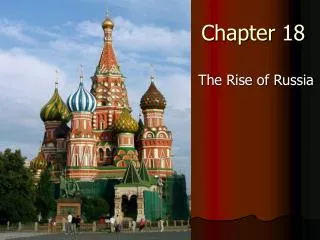
Chapter 18 The Rise of Russia
Themes of the Chapter • Territorial state huge land empire • Power of the tsars & the Romanov Dynasty (1610-1917) • Dominant aristocracy • Reliance on coercive labor systems • Lack of a merchant class • Dependence on the West
Russia Under the Czars • Remember from Ch. 14 that Moscow would become the center for resistance of Mongol rule
The Need for Revival (The Ivans) • Mongol Rule = limited cultural development, economic stagnation, dependence on peasant labor. • Ivan III (the Great) 1462-1505 • reclaims early Roman, Byzantine Christian traditions • Emphasis on military rule • Begins an expansionist policy
Light Green = land held by the end of Catherine the Great’s reign
Policies toward Native Peoples • Siberia is home to 26 ethnic groups, who responded to Russians in different ways • Russian gov’t uses cossacks and westerners (fur trade) to inhabit the area, but many inhabitants are social misfits • Russians wanted tribute in the form of furs, and resorted to violence to get it • By 1763, 420,000 Russians live in Siberia
Patterns of Expansion • Focused on Central Asia (lack of natural barriers made expansion easier) • Volga River (Astrakhan) becomes a bustling center for Eurasian trade • Tsars use new lands to reward faithful nobles/bureaucrats • New trade contacts w/Asia (Ottomans, Iran and India)
Question Slide • Compare contrast the map of the Mongol Empire & Russian Empire on the next two slides: • How accurate was the Russian claim that it was the heir of Chinggis Khan and the unifier of Central Asia? How were the empires different?
Ivan IV (the Terrible) 1533-1584 expanded borders and terrorized boyars Ivan IV got his nickname after murdering his eldest son
Western Contact • Tsars eager to make up for cultural isolation from Mongol polices by increasing contacts with Western Europe. This included: • Diplomatic missions to Europe • Western merchants establishing Russian trade centers • Using foreign artists to design Russian churches/public buildings
Romanov Policies • Time of Troubles = Ivan IV’s death (no heir) leads to a boyar power struggle • Romanov Dynasty (1613-1917) begins when boyars choose a Romanov to be Tsar • Michael= stabilizes gov’t, expands borders, drives out foreigners • Alexis = limits the power of nobility; resumes state control over the church
Russia’s 1st Westernization • 17th c. Russia = unusually agricultural compared to Europe & Asia • Peter the Great begins policies of westernization while continuing to old polices of expansion and tsarist control
Peter the Great (1689-1725) • Autocrat: • Used capital punishment, suppressed power of nobility, used secret police, militaristic • Westernization • Political = streamlines bureaucracy • Economic= built up mining/ iron industry • Social = encourages western styles among the upper classes (did not encourage gender equity); education for nobility
Results of Westernization • Changes were selective (did not impact the lower classes) • Serf labor expanded • Encouraged the autocratic state; didn’t challenge it • Widespread resentment as people clung to Russian traditions
Catherine the Great (1762-1796) • Claims power from husband after many years of weak rulers • Expands tsarist power (puts down the Pugachev Rebellion) • Enlightened Despot = courts Enlightenment ideals while being a traditional Russian ruler • Selective Westernizer = picks and chooses what she wants from the West
Her Policies • Political = increases power of nobility over the serfs, censors revolutionary ideas, crushes rebellions • Economic = further entrenches Russia into serfdom • Territorial= campaigns against the Ottoman Empire, claims Siberia and Alaska, claims part of Poland • Cultural = patronized Western art, architecture and clothing styles, but avoided other influences (French Revolution)
Themes in Early Modern Russian History • Serfdom • Economic dependence on the more industrially developed West • Social Unrest • Influence/control over Eastern Europe
Serfdom • Before Mongols, peasants were relatively free • 16th c. = serfdom used to appease nobles and extend state control • 1649 = serfdom become hereditary • 17th & 18th c. = laws tie serfs to land, give nobles great rights • Serfs were almost slaves
Trade & Economic Dependence • 95% of population is rural; few are artisans or merchants • Little incentive for agricultural or industrial innovation • Still manages to support nobility and a growing population
Social Unrest • 17th c. = revolutionary and Enlightenment ideals increase peasant discontent (Pugachev Rebellion) • 18th c. = reformers called for an end to serfdom and increased innovation • Tsars made few changes
Eastern Europe • Borders in this area fluctuate • Easter region help spread revolutionary Enlightenment ideas & take part in the Reformation • Still, E. Europe remains a place w/ a weakened central government and little economic development
Russia and the World • Becomes an absolute monarchy characterized by a “dominant aristocracy, coercive agricultural labor systems, and the absence of a a substantial merchant class.”