Download
1 / 22
220 likes | 340 Vues
This entry explores the characteristics shared by our favorite heroes, highlighting qualities that resonate with us. Drawing on the quote by Clint Eastwood about security and prejudice, we delve into the complexities of heroism, emphasizing how both personal and societal factors shape our perception of heroes. The discussion also touches on literary concepts like characterization and character types, enriching our understanding of what makes a hero relatable and admirable. Join us as we dissect these traits and why they matter in storytelling.

E N D
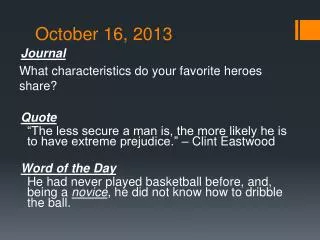
October 16, 2013 Journal What characteristics do your favorite heroes share? Quote “The less secure a man is, the more likely he is to have extreme prejudice.” – Clint Eastwood Word of the Day He had never played basketball before, and, being a novice, he did not know how to dribble the ball.
Novice (noun) • Novice (noun): a person who is new to the circumstances, work, etc.; a beginner; a noob
Reminders Short Stories: Oct. 23
Symbolism • Representing one thing with another.
Personification • Giving human characteristics to animals, non-living things, abstract concepts, or organizations.
Imagery • The mental creation of a picture from the author’s description.
First Person • The narrator is a character in the story and refers to him/herself as “I.”
Third Person Objective • Neither the reader nor the narrator are the main character. The narrator uses the pronouns “he” or “she” when referring to the main character and has no emotional stake in the story. The narrator simply tells the story.
Third Person Limited • The narrator only tells what is going on with one or two characters in their minds, usually only the main character.
Third Person Omniscient • The narrator can tell what is going on in the minds of all the characters.
Character Types • Stereotypical characters who make it easy to tell what is going on in a story.
Characterization • The way the author describes a character.
Round • A character whose personality, background, motives, and other features, are fully described by the author.
Flat • An easily recognized character type in fiction who may not be fully described but is useful in moving the story forward.
Protagonist • The main character. • The hero or heroine of a literary work.
Antagonist • A person who is opposed to, struggles against, or competes with another. • The adversary of the hero or protagonist.
Major • They will receive a large amount of "screen time". • They participate in significant chunks of the story - that is, they will have chapters of their own to be the narrator. • They will most likely have their own subplot.
Minor • They will receive very little "screen time". • They are unlikely to be used as a viewpoint character. • They won't have their own subplots (at least not a subplot of any great length or significance). • Their appearances in the novel will be brief and infrequent - although that doesn't mean that they can't shine vividly whenever they are in the spotlight.
Dynamic • A character that undergoes an important inner change (usually in attitude or personality).
Static • A character who undergoes little or no inner change; a character who does not grow or develop.
Stereotypes • What is a stereotype? • What are some of the stereotypes that you guys are familiar with? • Are stereotypes good or bad? • How do you use stereotypes in writing?
What a Character • I am going to give you one word and you need to describe to me, a person who fits that word.