Understanding the Formulas of Binary Ionic Compounds
840 likes | 972 Vues
This resource provides a comprehensive guide to writing and naming binary ionic compounds. It explains the characteristics of binary ionic compounds, including the composition of monatomic ions, positive and negative ion roles, and the importance of maintaining a neutral charge. The guide includes the criss-cross method for determining subscripts and features examples such as sodium chloride, magnesium chloride, and aluminum sulfide. Additionally, it introduces transition metal ions and their naming conventions.


Understanding the Formulas of Binary Ionic Compounds
E N D
Presentation Transcript
Writing Formulas of Ionic Compounds By Sharon Mace, West Stanly HS, NC
Binary Ionic Compounds: • Have only two types of elements. • Are made of monatomic ions only. • The name always ends in “-ide”. • The first ion is always positive. • The second ion is always negative. • They DO NOT have an overall charge. • They NEVER have ( )’s. (Parentheses are only used with more than oneof a polyatomic ion, never with a monatomic ion.)
Example:Sodium Chloride Na+1 Cl-1
Example:Sodium Chloride Na+1 Cl-1 It takes one of each ion to make a neutral compound.
Example:Sodium Chloride Na+1 Cl-1 It takes one of each ion to make a neutral compound. NaCl • NaCl
OR… Use the criss-cross method:
Example:Sodium Chloride Na+1 Cl-1
Example:Sodium Chloride Na+1 Cl-1 Take the 1 from the Na and put it as the invisible subscript on Cl.
Example:Sodium Chloride Na+1 Cl-1 Take the 1 from the Na and put it as the invisible subscript on Cl. Take the 1 from Cl and put it as the invisible subscript on Na.
Example:Sodium Chloride Na+1 Cl-1 Take the 1 from the Na and put it as the invisible subscript on Cl. Take the 1 from Cl and put it as the invisible subscript on Na. NaCl • NaCl
Example:Magnesium Chloride Mg+2 Cl-1
Example:Magnesium Chloride Mg+2 Cl-1 It takes one magnesium and two chlorides to make a neutral compound.
Example:Magnesium Chloride Mg+2 Cl-1 It takes one magnesium and two chlorides to make a neutral compound. Mg+2 + Cl-1 + Cl-1 = No charge
Example:Magnesium Chloride Mg+2 Cl-1 It takes one magnesium and two chlorides to make a neutral compound. Mg+2 + Cl-1 + Cl-1 = No charge MgCl2 • MgCl2
OR… Use the criss-cross method:
Example:Magnesium Chloride Mg+2 Cl-1
Example:Magnesium Chloride Mg+2 Cl-1 Take the 2 from the Mg and put it as the subscript on Cl.
Example:Magnesium Chloride Mg+2 Cl-1 Take the 2 from the Mg and put it as the subscript on Cl. MgCl2
Example:Magnesium Chloride Mg+2 Cl-1 Take the 2 from the Mg and put it as the subscript on Cl. MgCl2 Take the 1 from Cl and put it as the invisible subscript on Mg.
Example:Magnesium Chloride Mg+2 Cl-1 Take the 2 from the Mg and put it as the subscript on Cl. MgCl2 Take the 1 from Cl and put it as the invisible subscript on Mg. MgCl2 • MgCl2
Example:Aluminum Sulfide Al+3 S-2
Example:Aluminum Sulfide Al+3 S-2 It takes two aluminum ions and three sulfide ions to make a neutral compound.
Example:Aluminum Sulfide Al+3 S-2 It takes two aluminum ions and three sulfide ions to make a neutral compound. Al+3 + Al+3 + S-2 + S-2 + S-2 = No Charge
Example:Aluminum Sulfide Al+3 S-2 It takes two aluminum ions and three sulfide ions to make a neutral compound. Al+3 + Al+3 + S-2 + S-2 + S-2 = No Charge Al2S3 • Al2S3
OR… Use the criss-cross method:
Example:Aluminum Sulfide Al+3 S-2
Example:Aluminum Sulfide Al+3 S-2 Take the 3 from the Al and put it as the subscript on S.
Example:Aluminum Sulfide Al+3 S-2 Take the 3 from the Al and put it as the subscript on S. AlS3
Example:Aluminum Sulfide Al+3 S-2 Take the 3 from the Al and put it as the subscript on S. AlS3 Take the 2 from S and put it as the subscript on Al.
Example:Aluminum Sulfide Al+3 S-2 Take the 3 from the Al and put it as the subscript on S. AlS3 Take the 2 from S and put it as the subscript on Al. Al2S3 • Al2S3
Example:Magnesium Oxide Mg+2 O-2
Example:Magnesium Oxide Mg+2 O-2 It only takes ONE of each ion to make a neutral compound.
Example:Magnesium Oxide Mg+2 O-2 It only takes ONE of each ion to make a neutral compound. Mg+2 + O-2 = No charge
Example:Magnesium Oxide Mg+2 O-2 It only takes ONE of each ion to make a neutral compound. Mg+2 + O-2 = No charge MgCl2 • MgO
OR… Use the criss-cross method:
Example:Magnesium Oxide Mg+2 O-2 First, you must reduce the charge ratio! A +2 to -2 ratio cancels to +1 to -1:
Example:Magnesium Oxide Mg+2 O-2 First, you must reduce the charge ratio! A +2 to -2 ratio cancels to +1 to -1: Mg+1 O-1 NOW you can criss-cross:
Example:Magnesium Oxide Mg+2 O-2 First, you must reduce the charge ratio! A +2 to -2 ratio cancels to +1 to -1: Mg+1 O-1 NOW you can criss-cross: • MgO
Now you try it: Question answer • Potassium selenide • Aluminum phosphide • Beryllium carbide ________ ________ ________ Watch out for canceling!
Now you try it: Question answer • Potassium selenide • Aluminum phosphide • Beryllium carbide K2S AlP Be2C
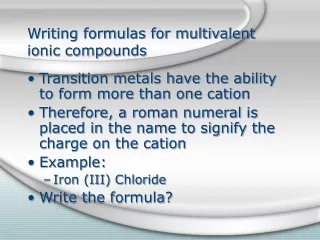
Adding Transition Metal Ions: When the name of a compound contains a transition metal ion, the Roman numeral or the classical name refers to the charge on the ion BEFORE you figure out the formula of the compound.
Example:Manganese (II) BromideORManganous Bromide: Mn+2 Br-1
Example:Manganese (II) BromideORManganous Bromide: Mn+2 Br-1 • MnBr2