Understanding the Mole: Mass, Molecules, and Empirical Formulas
720 likes | 879 Vues
Chapter 11 delves into the concept of the mole as a fundamental unit in chemistry, measuring the amount of substance and representative particles such as atoms, ions, and molecules. It explains the relationship between mass and moles, covering molar mass and conversions between mass and moles. The chapter also explores moles of compounds, empirical formulas, molecular mass, and the formula for hydrates, alongside calculating percent composition. By mastering these concepts, students will gain a strong foundation in quantitative chemistry.


Understanding the Mole: Mass, Molecules, and Empirical Formulas
E N D
Presentation Transcript
Chapter 11: The Mole • ____ 11.1 Measuring Matter • ____ 11.2 Mass and the Mole • ____ 11.3 Moles of Compounds • ____ 11.4 Empirical Formulas and Molecular Mass • ____ 11.5 The Formula for a Hydrate
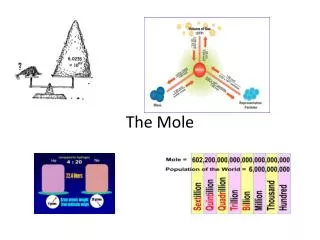
11.1 Measuring Matter • Counting Particles • What is a mole (commonly abbreviated mol) • The mole is the SI unit to measure the amount of a substance. • It is the number of representative particles, carbon atoms, in exactly 12g of pure carbon-12.
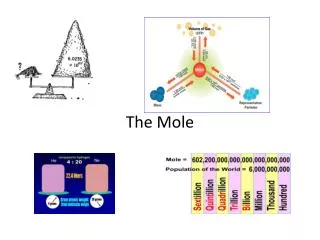
A mole of anything contains 6.02 X 10²³ representative particles. • A representative particle is any kind of particle such as atoms, molecules, formula units, electrons, or ions.
Avagadro’s Number (6.02 X 10²³) 602,000,000,000,000,000,000,000,000 • Converting Moles to Particles and Particles to Moles
1. 2.5 mol Zn X • = 1.51 X 1024 atoms Zn • 2. 3.25 mol AgNO3 X • = 1.96 X 1024 formula units AgNO3 • 3. 11.5 mol H2O X = 6.92 X 1024
Converting Particles to moles: simply multiply the number of particles by the conversion factor.
Ex: Calculate the number of moles that contain 4.5 X 1024 atoms of Zn.
4. a. 9.55 mol Al • b. 6.23 mol CO3 • c. 0.595 mol ZnCl2 • d. 4.15 X 10⁻⁴
Section 11.2 Mass and the Mole Molar mass The mass in grams of a mole of any pure substance is called its molar mass. The molar mass of any element is equal to its atomic mass and has the units g/mol. Ex. An atom of manganese has the atomic mass of 54.94 amu. Therefore its molar mass is 54.94g/mol
Mole to Mass Conversion Ex. What is the mass of 3.00 moles of Mn. • Conversion factor is 1 mole Mn = 54.9g
Answers • 11. a. 96.3 g Al • b. 1.2 X 10³ g Si • c. 203 g Co • d. 1.6 X 10² g Zn
Mass to Mole Conversion Ex. How many moles are there in 525g calcium?
Answers • 12. a. 0.236 mol Ag • b. 9.355 mol S • c. 1.91 mol Zn • d. 17.9 mol Fe
Conversions from mass to atoms and atoms to mass (this a two-step process) • Ex. How many atoms are in a 25g sample of pure gold?
Ex. How many atoms are in a 25g sample of pure gold? • Step 1 • Multiply the mass of gold by the molar mass conversion factor:
Ex. How many atoms are in a 25g sample of pure gold? • Step 2
Answers • a. 4.79 X 1024 atoms Li • b. 6.68 X 10²⁰ atoms Pb • c. 3.45 X 10²² atoms Hg • d. 9.77 X 10²³atoms Si • e. 1.51 X 1024 atoms Ti
Note: Mass must always be converted to moles before being converted to atoms, and atoms must first be converted to moles.
Although this is a two step process , you can make this conversion in one step. • Ex. How many molecules are in 1.00 g of H2O?
Ex. How many molecules are in 1.00 g of H2O? • You can set up the calculation like this: • The units all cancel to give the answer in molecules of H2O.
Answers • a. 2.09 X 10³ g Bi • b. 91.3 g Mn • c. 0.226 g He • d. 3.49 X 10⁻⁸g N • e. 5.93 X 10⁻⁷ g U
The Molar Mass of Compounds A mole of a compound would contain Avagadro’s number of molecules of that compound. • The mass of a mole of a compound equals the sum of the masses of every particle that makes up the compound.
The Molar Mass of Compounds • Ex. What is the mass of potassium chromate (K2CrO4)? • Use the periodic table to find the molar mass of each element and multiply it by the subscript. • K 39.1g X 2 = 78.2g • Cr 52.0g X 1 = 52.0g • O 16.0g X 4 = 64.0g • Molar mass of K2CrO4 = 194.2g
NaOH – 40.00 g • CaCl2 – 110.98g • KC2H3O2 – 98.14 g • Sr(NO3)2 – 211.64g • (NH4)3PO4- 149.10g
C2H5OH – 46.07g • C12H22O11- 342.30 g • HCN – 27.03 g • CCl4- 153.81 g • H2O – 18.02g
Converting Moles of a gas to volume • One mole of any gas at Standard Temperature and Pressure, occupies a volume of 22.4 Liters • STP – Standard Temperature and Pressure (room temp-25oC) (pressure at sea level 101kPa)
Converting Moles of a gas to volume • Ex. What is the volume of 2.5 moles of gas at STP? • 2.5 mol X = 61L of Gas • Ex What is the volume of 2g of H2 gas at STP? • First convert mass to moles. • 2gH2X 1 mole H2 X = 22.4L H2 2 g H2
Empirical and Molecular Formulas • Percent Composition from the chemical formula • The percent by mass of all the elements of a compound is called the percent composition of a compound.
Percent Composition from the Chemical Formula • Calculate the mass of each element in a compound and divide this value by the molar mass of the compound • Ex. What is the percent composition of H and O in water H2O • Mass of H = 2 X 1.01g • Mass of O = 16.00g
Empirical Formula • The empirical formula for a compound is the smallest whole number ratio of the elements.
Molecular Formula • Molecular Formula specifies the actual number of atoms of each element in one molecule or formula unit of a substance.