Advocacy and Case Management in Social Work
80 likes | 98 Vues
Explore advocacy dimensions, social worker traits, types of advocacy, goals, and effective strategies. Learn the principles of case management in engaging, planning, advocating, and evaluating.


Advocacy and Case Management in Social Work
E N D
Presentation Transcript
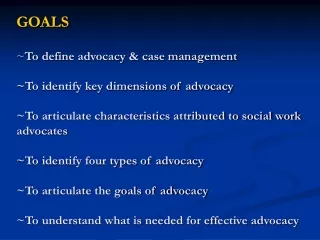
GOALS~To define advocacy & case management~To identify key dimensions of advocacy~To articulate characteristics attributed to social work advocates~To identify four types of advocacy~To articulate the goals of advocacy~To understand what is needed for effective advocacy
What is advocacy? • Definition Phases of generalist social work and advocacy practice Generalist ModelAdvocacy Model Engagement Getting involved Assessment Understanding the issue Planning Planning Intervention Advocating Evaluation Evaluation Termination Evaluation Follow-up Ongoing monitoring
What are some characteristics attributed to social work advocates? • Action oriented • Opposed to injustice • Not neutral • Links policy to practice • Patient and hopeful • Empowering
What are four types of advocacy? • Case/client • Cause • Legislative • Administrative
What are the goals of and indications for advocacy ? • Goals ~To make certain clients have access to existing rights and entitlements ~To initiate social action and secure new rights and entitlements • Indications
What are some things to know for effective advocacy ? • Client rights • Avenues of appeal • Available resources • Tactics and stragegies
What is the definition of case management ? • Definition: Linking client systems to needed resources