Starter
This resource provides insights into the fundamentals of electricity, distinguishing between conductors and insulators, and exploring the relationship between bonding types and melting points of substances. You'll learn that metals lose electrons to form positive ions, while non-metals gain electrons to form negative ions. The experiments classify different substances based on their conductivity and analyze how ionic, covalent, and molecular structures affect melting and boiling points. Perfect for chemistry students seeking to deepen their understanding of these concepts.

Starter
E N D
Presentation Transcript
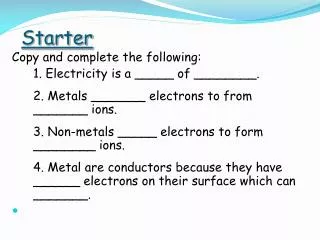
Starter Copy and complete the following: 1. Electricity is a _____ of ________. 2. Metals _______ electrons to from _______ ions. 3. Non-metals _____ electrons to form ________ ions. 4. Metal are conductors because they have ______ electrons on their surface which can _______.
Decide whether the following substances are conductors or insulators: Solid magnesium oxide Bromine liquid Molten copper (II) oxide Nitrogen gas Mercury Molten phosphorous Frozen pentane Carbon tetrachloride liquid Potassium bromide solution Nitrogen hydride gas Solid oxygen Sodium bromide solution. 1. Insulator 2. Insulator 3. Conductor 4. Insulator 5. Conductor 6. Insulator 7. Insulator 8. Insulator 9. Conductor 10. Insulator 11. Insulator 12. Conductor
Aim: • To investigate the relationship between type of bonding and melting point.
Method: Compounds to be tested
Conclusion: • In general, • Ionic compounds high melting points • Covalent compounds low melting points
Melting and Boiling Points of Substances Ionic solids • 3D rigid lattice where ions are held together by very strong bonds of attraction so lots of energy is needed to overcome this attraction. • Ionic solids tend to have high melting and boiling points. • For example, sodium chloride (NaCl)
Covalent Molecules • Have weak bond of attraction between molecules. • So very little energy is needed to overcome this attraction. • Therefore covalent molecules have relatively low melting and boiling points. • For example, carbon dioxide (CO2)
Covalent Networks • Contain special covalent bonds which are very strong. • Therefore a lot of energy is needed to overcome this. • Very high melting and boiling points. • For example, silicon dioxide (SO2)