Cell Membrane: Structure & Function
The cell membrane is essential for cellular integrity and function, primarily composed of lipids and proteins. Phospholipids are the most common type, featuring amphipathic properties that allow for fluidity and selective permeability. Membranes function as mosaics of various proteins embedded in a lipid bilayer, facilitating cell-cell recognition and transport. Key processes include passive transport of molecules, osmosis of water, and active transport against concentration gradients. Mechanisms such as exocytosis and endocytosis enable the transport of large molecules in and out of cells, crucial for cellular communication and homeostasis.

Cell Membrane: Structure & Function
E N D
Presentation Transcript
Cell Membrane:Structure & Function Ms. Levensailor
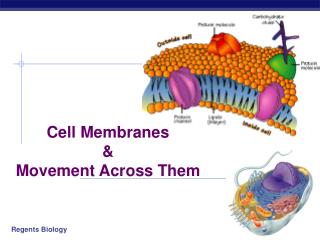
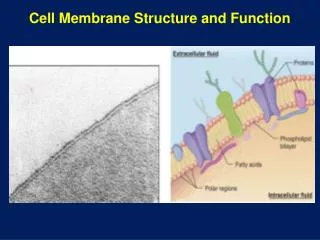
Staple ingredients of membranes are: Lipids Proteins Phospholipids are most common Amphipathic molecule: it has both a hydrophilic and hydrophobic region Membrane Structure
Membranes are fluid • Membranes are held together by hydrophobic interactions (much weaker than covalent bonds). • They must be fluid to work properly • When solid permeability changes & enzymatic proteins become inactive.
Membranes are mosaics of structure & function • A membrane is a collage of different proteins embedded in the fluid matrix of the lipid bilayer.
Membranes are mosaics of structure & function • Lipid bilayer is the main fabric of the membrane. • Proteins determine most of the membrane’s functions.
Membrane Carbohydrates • Important in cell to cell recognition: • A cell’s ability to distinguish between 1 type of neighboring cell from another. • i.e. identifying foreign cells (immune system) • Recognize other cells by keying in on surface molecules, carbohydrates, on the plasma membrane.
Selective Permeability • Substances do not cross the barrier indiscriminately! • Hydrophobic nonpolar molecules (hydrocarbons, carbon dioxide, & oxygen) cross with ease. • Hydrophilic polar molecules (ions) are impeded by the hydrophobic core of the membrane.
Transport Proteins • Proteins built into the membrane • Allow passage of hydrophilic substances. • Can be so specific that they only allow 1 specific substance to move through. • i.e. glucose carried in blood to the human liver enters liver cells rapidly through a specific transport protein. • It is so selective it rejects fructose (structural isomer of glucose).
Passive transport • Molecules have an intrinsic kinetic energy called thermal motion (heat). • A result of this is diffusion: • Tendency of molecules of any substance to spread out into available space. • A substance will diffuse from areas of high concentration to areas of low concentration. • Passive transport does not require energy!
Osmosis • The passive transport of water. • Hypertonic: solution with a higher concentration of solute. • Hypotonic: solution with a lower solute concentration. • Isotonic: solutions of equal solute concentration.
Cell survival depends on water uptake & loss • Cells w/out walls (animal cells) • If cell loses water it will shrivel • If cell takes up too much water it will burst • Cell w/ wall (plants & fungi) • If cell takes in water the wall exerts pressure back and prevents further uptake. • Isotonic solutions will make the plant limp. • If a cell loses water it will shrivel and the plasma membrane pulls away from the wall (plasmolysis).
Plasmolysis Hypertonic Hypotonic
Active Transport • The pumping of solutes against their gradients. • Across the plasma membrane from the side where they are less concentrated to the side where they are more concentrate. • Like moving “up hill” & requires work! • ATP supplies the energy for active transport. • i.e. sodium-potassium pump (online activity)
Exocytosis & Endocytosis • Transport large molecules (proteins & polysaccharides). • Exocytosis: cell secretes macromolecules by the fusion of vesicles with the plasma membrane. • Endocytosis: cell takes in macromolecules by forming new vesicles from the plasma membrane.