Understanding Low Density Polyethylene (LDPE) and Its Manufacturing Process
Low Density Polyethylene (LDPE) is produced at high pressures (1000–3000 atm) and temperatures around 500K, utilizing free radical initiation. The polymerization involves the formation of short branched chains, resulting in a degree of crystallinity that varies the material's density. In contrast, High Density Polyethylene (HDPE) is made at lower temperatures (350K) and pressures (1–50 atm) using Ziegler-Natta catalysts, yielding linear chains with minimal branching, leading to a rigid structure. This versatility makes LDPE and HDPE popular for various applications.

Understanding Low Density Polyethylene (LDPE) and Its Manufacturing Process
E N D
Presentation Transcript
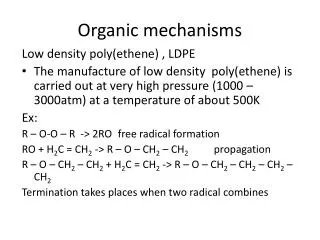
Organic mechanisms Low density poly(ethene) , LDPE • The manufacture of low density poly(ethene) is carried out at very high pressure (1000 – 3000atm) at a temperature of about 500K Ex: R – O-O – R -> 2RO free radical formation RO + H2C = CH2 -> R – O – CH2 – CH2 propagation R – O – CH2 – CH2 + H2C = CH2 -> R – O – CH2 – CH2 – CH2 – CH2 Termination takes places when two radical combines
Low density poly(ethene) , LDPE • An average polymer molecule with about from 4 x 10³ to 4 x 10⁴ carbon atoms with many short branches which affect both degree of crystalize and density of material
High density poly(ethene) , HDPE • HDPE is produced by polymerizing ethene at a low temperature ( 350K) and pressure ( 1 – 50atm) using a Ziegler – Naha catalyst. The catalyst is a suspension of titanium (iv) chloride together with an alkyl aluminium compound (Al(C2H5)3). • The result of polymer consist mainly of linear chains with very little branching. This gives it a higher density 0.96gcm-3 and a more rigid structure as the chains can fit together more closely. It is used to make containers and pipes