Download
1 / 16
160 likes | 287 Vues
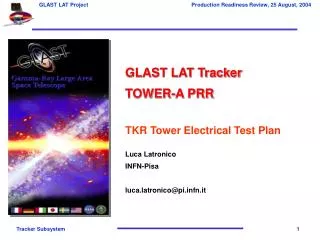
This analysis introduces new veto methodologies and topological classifications within TKR (Topology Schematic). We present three primary topological groups and outline pre-filtering strategies, including a veto against interrupted showers. Emphasis is placed on using ToT measurements to control heavy ions and range-outs, ensuring effective event discrimination. Key updates include a new background class identified by Robert Johnson and the implications of cuts on event efficiency. Our findings detail how targeted strategies enhance the rejection power while managing photon noise, ultimately improving the integrity of experimental outcomes.

E N D
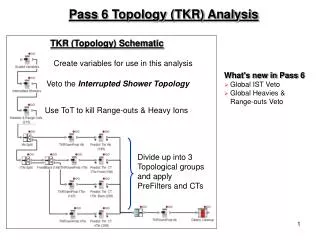
TKR (Topology) Schematic Create variables for use in this analysis Veto the Interrupted Shower Topology Use ToT to kill Range-outs & Heavy Ions Divide up into 3 Topological groups and apply PreFilters and CTs Pass 6 Topology (TKR) Analysis • What's new in Pass 6 • Global IST Veto • Global Heavies & Range-outs Veto
A New Background Class Identified (Robert Johnson) Incoming e+ and e- can interact in the first few layers going to an all-neutral state. The resulting gammas can then pair convert particularly in the thick layers.
Interrupted Shower Cut AcdTileEventEnergyRatio > max(.003, (6 - TkrUpstreamHC)* .006) & AcdTileEventEnergyRatio > (-.015 - .00002*AcdTkr1ActiveDistENorm) & TkrUpstreamHC > 0 Events in RED - Vetoed Note: This cut could be broken out as a separate stand-alone cut to improve efficiency for some Event Classes What's Killed What's Left Max loss: ~ 7% around 500-1000 MeV
Heavy Ions & Range outs from Below MIP Range Outs Tracker ToTs give a dE/dX meas. Plotting Tkr1ToTFirst vs CTBBestLogEnergy suggested that scaling the ToT to energy had merit: ScaledToT = Tkr1FirstTot * 2.5/CTBBestLogEnergy Decoding by Source Type Heavies & Range Out Cut Tkr1ToTFirst < .2 & CTBBestEnergy < 25000) | Tkr1ToTFirst * 2.5/CTBBestLogEnergy > 6.5
Totals Totals Which Sources are Effected by these new vetos Heavy Ion / Range-out Veto Interupted Shower Veto The IS Veto seems to take out more then just e+/e- The HR Veto does its job well
Topology Classes VTX Tkr1CoreHC is the number of extra hits close to the first track. Electrons/positrons like to make lots of delta-rays. You can use this variable directly or as a ratio to the number of hits on the first track
Another good discriminator is the track-dispersion. This variable measure how spread out the various found tracks are in the detector. EM showers make bundles of closely packed tracks VTX Topology Veto Tkr1CoreHC > 1 & TkrDispersion < 400
TKR VTX CT NodeSplit/Remainder: 30/10 6 Trees 2k/Tree
1Tkr Front Again it’s a question of which to use: the scaled Core Hit Count or 1Tkr Front Veto Tkr1CoreHC < 2 This seems like a big hit, except there are not a lot of Gammas in this class
TKR 1Tkr Front CT Node Split/Remainder: 30/10 5 Trees 2k/Tree
Note: The numbers in various parts here are not the same due to different data samples that were used over time to do this: v13r7, v13r9, and partial and full samples 1Tkr Back 1 Tkr Back Veto Tkr1CoreHC < 1 This is more serious. There are just very few handles on these events. They are dirty
TKR 1Tkr Back CT Node Split/Remainder: 30/10 20 Trees 2.5k/Tree
nTKR Topology nTkr Topology Veto Tkr1CoreHCRatio > .1 & CTBBestEnergy > 50 & TkrDispersion < 300
TKR nTkr CT Node Split/Remainder: 30/10 20 Trees 3k/Tree
Pass 5 - Pass 6 PreFilter Comparison Pass 6 sacrofices 3.5% Gamma efficiency for a 1.5x improvement in background rejection power
Pass 5 - Pass 6 CT Comparison Pass 5 Pass 6