Exploring Slope Fields and Solution Curves for Differential Equations
This document explores the relationship between a function ( y ) and its slope ( y' ) using slope fields and solution curves. It investigates six distinct values of ( C ) in the context of the differential equation ( y' = C ) and evaluates whether the curves represent solutions to initial value problems (IVPs). Additionally, it examines the equation ( y = x^2 + 3x + c ) and determines its derivative, ( y' = 2x + 3 ), to analyze graphical representations of these relationships and the behavior of solutions around specified initial conditions.

Exploring Slope Fields and Solution Curves for Differential Equations
E N D
Presentation Transcript
Let y = Cet. Determine y’. • What does this tell us about the relationship between y and the slope of y at any point (t,y)?
Your graphs collectively are known as solution curves for y’= Cet. • From your solutions curves for y’ = Cet, determine if one is a solution to the ivp y’ = y (0, -1)
Let y = x2 + 3x + c • Determine y’. • What does this tell us about the relationship between y and the slope of y at any point (x,y)?
Your graphs collectively known as solution curves for y’= 2x + 3. • From your solution curves for y’ = 2x + 3, determine if one is a solution to the ivp y’ = 2x + 3 (0,2)
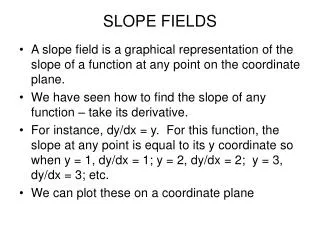
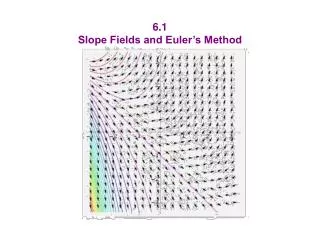
Slope Fields • Slope fields are a graphical way of solving differential equations. • More specifically, a slope field shows the slope of a solution curve through every point (with integer values) on the coordinate grid.
Solving des and ivps graphically • For an ivp • y’ = f(t,y) y(a) = b • the initial condition tells you where to start (a,b). From the initial condition point “go with the flow” in both directions using the segments as a guide.
Classwork • page 631, • #3 and 5
Assignment • Theme 11 Worksheet and slope fields matching # 7 - 12