Understanding the Nervous System: Structure, Function, and Electrical Activity
The nervous system is the master controlling and communicating system of the body, responsible for sensory input, integration, and motor output. It consists of the central nervous system (CNS)—comprising the brain and spinal cord—and the peripheral nervous system (PNS)—which includes spinal and cranial nerves. Key components include neurons, responsible for transmitting signals, and glial cells providing support. The activity of neurons involves complex electrical processes, including resting membrane potential, action potentials, and the function of ion channels, which are crucial for communication within the nervous system.

Understanding the Nervous System: Structure, Function, and Electrical Activity
E N D
Presentation Transcript
Nervous System • The master controlling and communicating system of the body • Functions • Sensory input – monitoring stimuli occurring inside and outside the body • Integration – interpretation of sensory input • Motor output – response to stimuli by activating effector organs
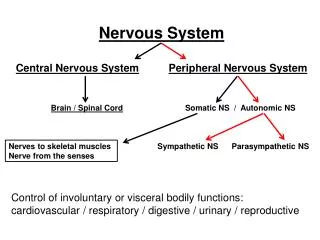
Organization of Nervous System • Central nervous system (CNS) • Brain and spinal cord • Integration and command center • Peripheral nervous system (PNS) • Paired spinal and cranial nerves • Carries messages to and from the spinal cord and brain
Organization of PNS PNS Sensory (afferent) Division Motor (efferent) Division Somatic NS Autonomic NS
Cells of the Nervous System • The two principal cell types of the nervous system are: • Neurons – excitable cells that transmit electrical signals • Supporting cells – cells that surround and wrap neurons • known as neuroglia or glial cells • Provide a supportive scaffolding for neurons • Segregate and insulate neurons • Guide young neurons to the proper connections • Promote health and growth
Neurons (Nerve Cells) • Structural units of the nervous system • Composed of a body, axon, and dendrites • Long-lived, amitotic, and have a high metabolic rate • Their plasma membrane functions in electrical signaling
Nerve Cell Body (Soma) • Contains the nucleus and a nucleolus • Is the major biosynthetic center • Is the focal point for the outgrowth of neuronal processes • Has no centrioles (hence its amitotic nature) • Contains an axon hillock – cone-shaped area from which axons arise
Processes • Armlike extensions from the soma • There are two types: axons and dendrites Dendrites: • Short, tapering, and diffusely branched processes • They are the receptive, or input, regions of the neuron • Electrical signals are conveyed as graded potentials
Processes (Axons) Axons: • Slender processes arising from the hillock • Long axons are called nerve fibers • Usually there is only one unbranched axon per neuron • Axonal terminal – branched terminus of an axon • Generate and transmit action potentials • Secrete neurotransmitters from the axonal terminals
Myelin Sheaths • Whitish, fatty (protein-lipoid), segmented sheath around most long axons • It functions to: • Protect the axon • Electrically insulate fibers from one another • Increase the speed of nerve impulse transmission • Formed by Schwann cells in the PNS • Nodes of Ranvier - Gaps in the myelin sheath between adjacent Schwann cells
Myelin Sheath Formation • White matter – dense collections of myelinated fibers • Gray matter – mostly soma and unmyelinated fibers
Neuron Classification • Structural: • Multipolar — three or more processes • Bipolar — two processes (axon and dendrite) • Unipolar — single, short process • Functional: • Sensory (afferent) — transmit impulses toward the CNS • Motor (efferent) — carry impulses away from the CNS • Interneurons (association neurons) — shuttle signals through CNS pathways
Electricity Terms • Voltage (V) – measure of potential energy generated by separated charge • Potential difference – voltage measured between two points • Current (I) – the flow of electrical charge between two points • Resistance (R) – hindrance to charge flow • Insulator – substance with high electrical resistance • Conductor – substance with low electrical resistance
Ion Channels • Types of plasma membrane ion channels: • Passive, or leakage, channels – always open • Chemically gated channels – open with binding of a specific neurotransmitter • Voltage-gated channels – open and close in response to membrane potential • Mechanically gated channels – open and close in response to physical deformation of receptors
Resting Membrane Potential • The potential difference (–70 mV) across the membrane of a resting neuron • It is generated by different concentrations of Na+, K+, Cl, and protein anions (A) • Ionic differences are the consequence of: • Differential permeability of Na+ and K+ • Operation of the sodium-potassium pump
Resting Membrane Potential http://bcs.whfreeman.com/thelifewire/content/chp44/4401s.swf
Membrane Potentials: Signals • Used to integrate, send, and receive information • Membrane potential changes are produced by: • Changes in membrane permeability to ions • Alterations of ion concentrations across the membrane • Types of signals – graded potentials and action potentials
Changes in Membrane Potential • Changes are caused by three events • Depolarization – the inside of the membrane becomes less negative • Repolarization – the membrane returns to its resting membrane potential • Hyperpolarization – the inside of the membrane becomes more negative than the resting potential
Action Potentials • A brief reversal of membrane potential with a total amplitude of 100 mV • Action potentials are only generated by muscle cells and neurons • They do not decrease in strength over distance • They are the principal means of neural communication • An action potential in the axon of a neuron is a nerve impulse
Action Potential: Resting State • Na+ and K+ channels are closed • Leakage accounts for small movements of Na+ and K+ • Each Na+ channel has two voltage-regulated gates • Activation gates – closed in the resting state • Inactivation gates – open in the resting state
Action Potential: Depolarization • Na+ permeability increases; membrane potential reverses • Na+ gates are opened; K+ gates are closed • Threshold – a critical level of depolarization (-55 to -50 mV) • At threshold, depolarization becomes self-generating
Action Potential: Repolarization • Sodium inactivation gates close • Membrane permeability to Na+ declines to resting levels • As sodium gates close, voltage-sensitive K+ gates open • K+ exits the cell and internal negativity of the resting neuron is restored http://www.horton.ednet.ns.ca/staff/selig/Secure/nervous/ap3.htm
Phases of the Action Potential • 1 – resting state • 2 – depolarization phase • 3 – repolarization phase • 4 – hyperpolarization
Synapses • A junction that mediates information transfer from one neuron: • To another neuron • To an effector cell • Presynaptic neuron – conducts impulses toward the synapse • Postsynaptic neuron – transmits impulses away from the synapse
Types of Synapses • Electrical synapses: • Are less common than chemical synapses • Are important in the CNS in: • Arousal from sleep, mental attention, emotions and memory, ion and water homeostasis • Chemical synapses: • Release and reception of neurotransmitters • Typically composed of two parts: • Axonal terminal of the presynaptic neuron, which contains synaptic vesicles • Receptor region on the dendrite(s) or soma of the postsynaptic neuron
Synaptic Cleft: Info. Transfer • Nerve impulses reach the axonal terminal of the presynaptic neuron and open Ca2+ channels • Neurotransmitter is released into the synaptic cleft via exocytosis • Neurotransmitter crosses the synaptic cleft and binds to receptors on the postsynaptic neuron • Postsynaptic membrane permeability changes, causing an excitatory or inhibitory effect
Neurotransmitters • Chemicals used for neuronal communication with the body and the brain • 50 different neurotransmitters have been identified • Classified chemically and functionally • Acetylcholine (ACh) • Biogenic amines • Amino acids • Peptides • Novel messengers: ATP and dissolved gases NO and CO
Neurotransmitters • Acetylcholine (Ach) • Released at the neuromuscular junction • Released by all neurons that stimulate skeletal muscle • Dopamine, norepinephrine (NE), and epinephrine • Indolamines – serotonin and histamine http://www.paxil.com/flash/depression.swf • Roles in emotional behaviors and our biological clock • Amino Acids - GABA – Gamma ()-aminobutyric acid, Glycine, Aspartate, Glutamate
More Neurotransmitters • Peptides - • Substance P – mediator of pain signals • Beta endorphin, dynorphin, and enkephalins • Act as natural opiates, reducing our perception of pain • Bind to the same receptors as opiates and morphine • Gut-brain peptides – somatostatin, and cholecystokinin
Brain Protection • The brain is protected by bone, meninges, and cerebrospinal fluid • Harmful substances are shielded from the brain by the blood-brain barrier • Functions of the meninges • Cover and protect the CNS • Protect blood vessels and enclose venous sinuses • Contain cerebrospinal fluid (CSF) • Form partitions within the skull
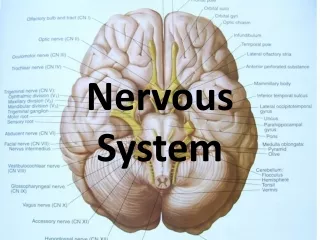
Organization of the Brain • Cerebral hemispheres • Diencephalon • Brain Stem (midbrain, pons, medulla) • Cerebellum
Cerebral Hemispheres • Form the superior part of the brain and make up 83% of its mass • Contain ridges (gyri) and shallow grooves (sulci) • Contain deep grooves called fissures • Are separated by the longitudinal fissure • Have three basic regions: cortex, white matter, and basal nuclei
Cerebral Cortex • The cortex – superficial gray matter; accounts for 40% of the mass of the brain • Enables sensation, communication, memory, understanding, and voluntary movements; conscious mind • Each hemisphere acts contralaterally (controls the opposite side of the body) • Hemispheres are not equal in function • No functional area acts alone; conscious behavior involves the entire cortex • Three functional areas: motor, sensory and association areas
Cerebral Cortex - Motor Areas • Primary (somatic) motor cortex: conscious control of precise, skilled, voluntary movements • Premotor cortex: learned, repetitious, or patterned motor skills; coordinates simultaneous or sequential actions; involved in the planning of movements • Broca’s area: motor speech area that directs muscles of the tongue; is active as one prepares to speak • Frontal eye field: controls voluntary eye movement
Cerebral Cortex - Sensory Areas • Primary somatosensory cortex: receives information from the skin and skeletal muscles; exhibits spatial discrimination • Somatosensory association cortex: integrates sensory information; forms comprehensive understanding of the stimulus; determines size, texture, and relationship of parts • Visual and auditory areas: receives visual information from the retinas • Olfactory, gustatory, and vestibular cortices: receives information related to pitch, rhythm, and loudness